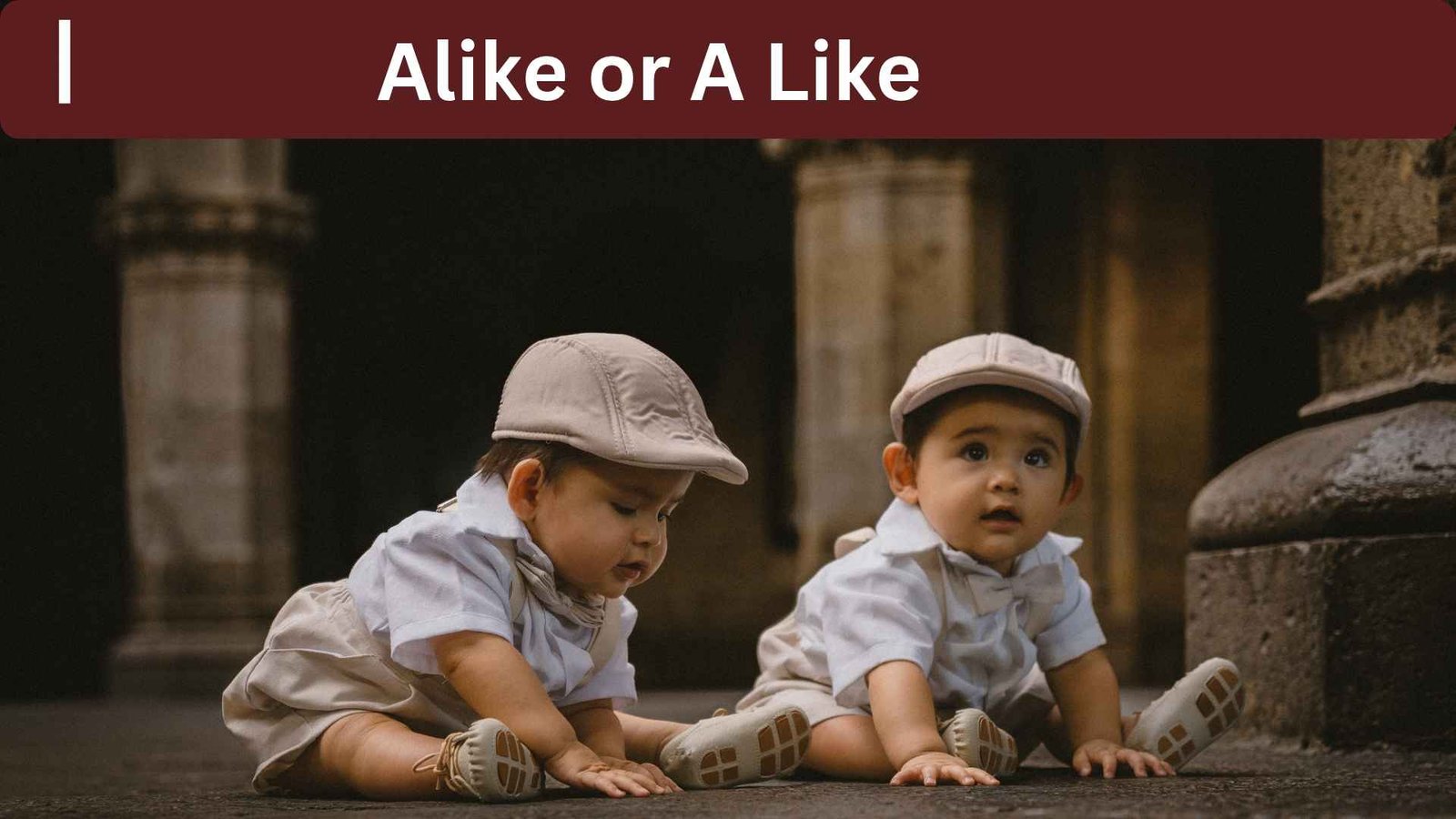
Alike or a like is a common spelling question that confuses English learners and even experienced writers. Both expressions are grammatically correct in certain situations, but they have different meanings and uses. Choosing the wrong form can change the meaning of your sentence or make it grammatically incorrect.
The word alike means similar in appearance, behavior, personality, or characteristics. It is commonly used when comparing two or more people, objects, or situations. In contrast, a like is a two-word phrase that usually refers to a single expression of approval, particularly on social media.
For example, “The two sisters look alike” describes their similar appearance. However, “My photo received a like” refers to a positive reaction.
Understanding these differences will help you improve your grammar, spelling, and sentence construction.
This guide explains the meaning of alike or a like, their grammatical functions, pronunciation, common mistakes, sentence examples, and practical rules for choosing the correct expression.
Alike or A Like: Quick Answer
Use “alike” when describing similarities between people or things. Use “a like” when referring to one countable expression of approval or appreciation.
Both expressions are correct, but they cannot replace each other in most sentences.
| Feature | Alike | A Like |
|---|---|---|
| Meaning | Similar or resembling each other | One expression of approval |
| Spelling | One word | Two words |
| Part of speech | Adjective or adverb | Article + noun |
| Main purpose | Expressing similarity | Referring to a reaction |
| Common context | Everyday comparisons | Social media |
| Example | The twins look alike. | My post received a like. |
| Pronunciation | uh-LIKE | uh LIKE |
| Correct usage | They think alike. | She gave my video a like. |
Simple rule: If your sentence means “similar,” choose alike. If it refers to one positive reaction, choose a like.
What Does Alike Mean?
The word alike means similar, resembling one another, or sharing noticeable characteristics.
It describes similarities in appearance, behavior, personality, opinions, actions, or other qualities.
For example:
- The two brothers look alike.
- These houses are remarkably alike.
- Both children think alike.
- Their personalities are surprisingly alike.
- The paintings look almost alike.
In each example, “alike” expresses a relationship of similarity.
However, alike does not always mean that two things are completely identical. People or objects can look alike while still having differences.
Alike as an Adjective
Alike functions as an adjective when describing the similarity between people or things.
Unlike many ordinary adjectives, it usually appears after a linking verb rather than directly before a noun.
Common linking verbs include:
- Be
- Look
- Seem
- Appear
- Remain
Examples:
- The sisters are alike.
- These flowers look alike.
- Their opinions seem alike.
- The buildings appear alike.
- Both designs are almost alike.
In these sentences, alike describes the subjects.
Grammar tip: Do not normally place “alike” directly before a noun.
Incorrect: They bought alike dresses.
Correct: They bought similar dresses.
Correct: Their dresses look alike.
The adjective “similar” is generally more suitable before a noun.
Alike as an Adverb
Alike can also function as an adverb.
In this role, it describes how people perform actions in similar ways.
Examples:
- Great minds think alike.
- The brothers dress alike.
- Both students answered alike.
- The dancers move alike.
- The children reacted alike.
Here, alike modifies verbs such as think, dress, answer, move, or react.
Alike Meaning Equally
Alike can also mean equally or in the same manner, especially when referring to two groups.
Examples:
- The rules apply to teachers and students alike.
- The museum welcomes children and adults alike.
- The decision affects employees and managers alike.
- The event attracted beginners and experts alike.
This usage is common in formal writing.
It emphasizes that different people or groups are included equally.
What Does A Like Mean?
The expression a like consists of two separate words.
The article “a” comes before the noun “like.”
In modern English, “a like” commonly refers to one positive reaction to online content.
For example:
- My picture received a like.
- She gave my Facebook post a like.
- His comment received a like.
- I got a like on my latest video.
- Every like helps show audience engagement.
In these examples, “like” is a countable noun.
A Like as a Noun Phrase
A noun phrase is a group of words built around a noun.
In the expression “a like”:
- “A” is an indefinite article.
- “Like” is a singular countable noun.
- Together, they form a noun phrase.
Consider this sentence:
My photo received a like.
The phrase “a like” functions as the direct object of the verb “received.”
Another example:
She gave my video a like.
Here, “a like” refers to one positive reaction.
A Like in Social Media
The expression is particularly common when discussing online engagement.
Examples:
- My Instagram picture received a like.
- He gave my video a like.
- Her comment received a like within seconds.
- I noticed a like on my latest post.
- A like can show appreciation for someone’s content.
In these sentences, the expression refers to a measurable reaction.
Is A Like Grammatically Correct?
Yes, a like is grammatically correct when “like” functions as a singular countable noun.
However, it is incorrect when used to describe similarity.
Incorrect: The twins look a like.
Correct: The twins look alike.
Correct: The twins’ picture received a like.
The correct choice depends on the intended meaning.
Alike or A Like: Main Differences
Although alike or a like may sound similar, their meanings, grammatical functions, and sentence structures are different.
Difference in Meaning
“Alike” describes similarity.
Example:
The two dogs look alike.
This sentence means the dogs have similar appearances.
“A like” refers to one expression of approval.
Example:
The dog’s photo received a like.
This sentence means someone reacted positively to the photo.
Difference in Grammar
“Alike” can function as an adjective or adverb.
Examples:
- The brothers are alike.
- They think alike.
“A like” functions as a noun phrase.
Examples:
- My post received a like.
- She gave the picture a like.
Difference in Sentence Structure
Alike often follows linking verbs or modifies action verbs.
Examples:
- They look alike.
- They behave alike.
- Their opinions are alike.
A like usually appears where a noun phrase can function as an object or subject.
Examples:
- He received a like.
- She gave the post a like.
- A like appeared on the photo.
Difference in Context
Alike is widely used in everyday English, academic writing, descriptions, and comparisons.
A like is especially common in digital communication.
Difference in Spelling
Alike is written as one word when expressing similarity.
A like is written as two words when the article “a” modifies the noun “like.”
Confusing these spellings can create grammatical errors.
When to Use Alike in English
Use alike when comparing people, objects, appearances, personalities, opinions, or actions.
Describing Similar Appearances
Examples:
- The identical twins look alike.
- These two cars look alike.
- Both houses are alike in design.
- The kittens look remarkably alike.
- Their handwriting looks alike.
The word emphasizes resemblance.
Describing Similar Personalities
Examples:
- The brothers are alike in many ways.
- Both friends think alike.
- Their personalities are surprisingly alike.
- The students seem alike in temperament.
- The children behave alike.
These sentences describe shared personality traits or behaviors.
Describing Similar Objects
Examples:
- The two phones look alike.
- These paintings are almost alike.
- Both chairs are alike in shape.
- The buildings look alike from a distance.
- The designs are remarkably alike.
Describing Similar Actions
Examples:
- The dancers move alike.
- Both students answered alike.
- The twins dress alike.
- The workers responded alike.
- The children reacted alike.
In these examples, alike describes the manner in which actions occur.
When to Use A Like in English
Use a like when referring to a single countable expression of approval.
This usage is especially common in online conversations.
A Like in Social Media Sentences
Examples:
- My Instagram photo received a like.
- She gave my Facebook post a like.
- His comment received a like.
- I got a like on my latest video.
- Every like represents a positive reaction.
A Like in Everyday Conversations
Examples:
- I noticed a like on my recent post.
- She received a like from her friend.
- He gave the picture a like.
- My comment received a like within seconds.
- A like can encourage someone to share more content.
Can A Like Have Other Meanings?
Yes. The words “a” and “like” can appear next to each other in other grammatical constructions.
For example:
She is a like-minded person.
Here, “a” is the article before the compound adjective “like-minded,” which modifies “person.”
However, this is not the same construction as the standalone noun phrase “a like.”
In ordinary usage, “a like” most often refers to one positive reaction.
Alike or A Like: Correct and Incorrect Sentences
The following table explains common spelling mistakes.
| Incorrect Sentence | Correct Sentence | Reason |
|---|---|---|
| The twins look a like. | The twins look alike. | Describes similarity |
| Both friends think a like. | Both friends think alike. | Describes similar thinking |
| These houses are a like. | These houses are alike. | Expresses resemblance |
| The sisters dress a like. | The sisters dress alike. | Describes similar behavior |
| My photo received alike. | My photo received a like. | Refers to a reaction |
| He gave my post alike. | He gave my post a like. | Refers to one expression of approval |
| The paintings look a like. | The paintings look alike. | Describes appearance |
| Their opinions are a like. | Their opinions are alike. | Expresses similarity |
The easiest way to choose correctly is to understand what the sentence communicates.
Alike or A Like: Pronunciation Guide
Both expressions can sound almost identical in natural speech.
This similarity in pronunciation is one reason people confuse their spellings.
How to Pronounce Alike
The pronunciation of alike is:
/əˈlaɪk/
It has two syllables:
uh-LIKE
The stress falls on the second syllable.
Example:
“The sisters look alike.”
How to Pronounce A Like
The phrase “a like” is commonly pronounced:
/ə laɪk/
When spoken naturally, it can sound very similar to “alike.”
Example:
“My photo received a like.”
How to Identify the Correct Form
Pronunciation alone may not reveal the intended spelling.
Instead, examine the sentence.
If the sentence describes resemblance, use alike.
If it refers to one countable expression of approval, use a like.
Alike or Similar: What Is the Difference?
The words alike or similar both express resemblance.
However, their grammatical placement differs.
Meaning of Similar
Similar means sharing characteristics, features, or qualities.
Examples:
- They have similar interests.
- Both houses have similar designs.
- Their personalities are similar.
Unlike alike, similar can appear directly before a noun.
Alike or Similar in Sentences
| Alike | Similar |
|---|---|
| The brothers look alike. | The brothers look similar. |
| Their opinions are alike. | Their opinions are similar. |
| The dresses look alike. | They bought similar dresses. |
| The cars are alike in design. | The cars have similar designs. |
Both words are useful, but their sentence structures are not always interchangeable.
Can You Say Alike People?
In standard modern English, “alike people” is not the usual expression when describing people who are similar.
Incorrect: They are alike people.
Better: They are similar people.
Correct: The people are alike in many ways.
This distinction is especially important in formal writing.
Alike or Like: Understanding the Difference
Another common confusion involves alike or like.
Both words can express similarity, but they have different grammatical roles.
Using Like for Comparisons
Like often functions as a preposition when comparing one person or object with another.
Examples:
- She looks like her mother.
- This car looks like mine.
- He behaves like his brother.
- The building looks like a castle.
The word “like” introduces the comparison.
Using Alike for Comparisons
Alike describes a shared similarity.
Examples:
- She and her mother look alike.
- The two cars look alike.
- The brothers behave alike.
- Both buildings look alike.
Important Grammar Rule
Correct: She looks like her sister.
Correct: She and her sister look alike.
Incorrect: She looks alike her sister.
The last sentence is incorrect because alike does not function as a preposition in this construction.
Look Alike or Look A Like: Which Is Correct?
The correct expression is look alike when describing people or things with similar appearances.
For example:
- The twins look alike.
- These houses look alike.
- Both dogs look alike.
- The sisters look alike.
Writing “look a like” is incorrect when you mean “look similar.”
Lookalike as a Noun
The related word lookalike is commonly written as one word when used as a noun.
A lookalike is someone who closely resembles another person.
Examples:
- He is a famous actor’s lookalike.
- The celebrity met her lookalike.
- His lookalike appeared on television.
Look-Alike as an Adjective
The hyphenated form look-alike can function as an adjective before a noun.
Examples:
- They wore look-alike costumes.
- The shop sells look-alike handbags.
- The children have look-alike outfits.
The spelling depends on the grammatical function and the style guide being followed.
Common Mistakes With Alike or A Like
Several mistakes occur because the expressions sound similar.
Mistake 1: Using A Like for Similarity
Incorrect: My brothers look a like.
Correct: My brothers look alike.
Explanation: Alike describes similar appearances.
Mistake 2: Placing Alike Before a Noun
Incorrect: They have alike personalities.
Correct: They have similar personalities.
Explanation: Similar is generally preferred directly before a noun.
Mistake 3: Using Alike Instead of Like
Incorrect: She looks alike her mother.
Correct: She looks like her mother.
Explanation: Like introduces the person being compared.
Mistake 4: Using Alike for a Reaction
Incorrect: My post received alike.
Correct: My post received a like.
Explanation: Like functions as a countable noun.
Mistake 5: Assuming Alike Means Identical
Alike does not necessarily mean exactly the same.
Example:
The two houses look alike.
This means the houses share noticeable features, not that every detail is identical.
Synonyms of Alike With Examples
Synonyms help writers express similar ideas without repeating the same word.
| Synonym | Meaning | Example |
|---|---|---|
| Similar | Sharing characteristics | Their ideas are similar. |
| Comparable | Having features that can be compared | The results are comparable. |
| Resembling | Looking similar to something | The child resembles his father. |
| Matching | Corresponding in appearance | They wore matching shirts. |
| Identical | Exactly the same | The two copies are identical. |
| Equivalent | Equal in value or meaning | The expressions are equivalent. |
Is Alike the Same as Identical?
Not exactly.
Alike generally means similar.
Identical means exactly the same in the relevant respects.
Examples:
- The two paintings look alike.
- The two printed copies are identical.
The first sentence suggests resemblance.
The second indicates an exact match.
Antonyms of Alike
Antonyms are words with opposite meanings.
Common antonyms of alike include:
- Different
- Dissimilar
- Unlike
- Distinct
- Contrasting
Examples:
- The brothers look different.
- Their opinions are dissimilar.
- The two designs are distinct.
- Their personalities are unlike each other.
- The paintings have contrasting styles.
These words help describe differences instead of similarities.
Common English Expressions Using Alike
The word alike appears in several familiar English expressions.
Great Minds Think Alike
Meaning: People with similar ideas sometimes reach the same conclusion.
Example:
“We both chose the same answer. Great minds think alike!”
This expression is often used humorously.
Look Alike
Meaning: To have similar appearances.
Example:
“The two sisters look alike.”
Treat Everyone Alike
Meaning: To treat people equally.
Example:
“A good teacher should treat all students alike.”
Here, alike means equally.
Think Alike
Meaning: To share similar opinions or ideas.
Example:
“Best friends often think alike.”
Alike in Many Ways
Meaning: To share several characteristics.
Example:
“The two countries are alike in many ways.”
This expression is useful in comparisons and academic writing.
How to Remember Alike or A Like
A few simple memory tricks can prevent spelling mistakes.
Remember Alike Means Similar
Think of this sentence:
Twins look alike.
If you are describing similarity, write alike as one word.
Remember A Like Means One Reaction
Think of a social media post.
My picture received a like.
Here, the article “a” indicates one countable reaction.
Use the Similarity Test
Ask yourself:
“Am I describing how two people or things are similar?”
If yes, use alike.
Use the Reaction Test
Ask yourself:
“Am I referring to one positive reaction?”
If yes, use a like.
These tests will help you choose the correct expression in most everyday situations.
Alike or A Like: Practice Exercises
Test your knowledge by completing the following sentences.
Fill in the Blanks
Choose alike or a like.
- The two brothers look ______.
- My latest picture received ______.
- These houses are remarkably ______.
- The twins think ______.
- She gave my video ______.
- Both students answered ______.
- Their personalities are ______.
- His comment received ______.
- The two kittens look ______.
- The dancers move ______.
Correct Answers
| Question | Correct Answer |
|---|---|
| 1 | Alike |
| 2 | A like |
| 3 | Alike |
| 4 | Alike |
| 5 | A like |
| 6 | Alike |
| 7 | Alike |
| 8 | A like |
| 9 | Alike |
| 10 | Alike |
These exercises reinforce the grammatical differences between the expressions.
Frequently Asked Questions About Alike or A Like
Is It Alike or A Like?
Both expressions are correct in different contexts. Alike means similar, while a like commonly refers to one positive reaction on social media.
Is Alike One Word or Two Words?
Alike is always written as one word when describing similarity.
Example:
“The twins look alike.”
Is A Like a Real Word?
A like is not a single word. It is a grammatically correct two-word noun phrase consisting of the article “a” followed by the noun “like.”
Is It Look Alike or Look A Like?
Look alike is correct when describing similar appearances.
Example:
“The sisters look alike.”
Is It They Look Alike or They Look A Like?
“They look alike” is correct because alike describes the similarity between the people.
Can Alike Be Used for People?
Yes. Alike can describe people who share similar appearances, personalities, opinions, or behaviors.
Example:
“The two friends are alike in many ways.”
Can Alike Be Used for Objects?
Yes. It can describe objects that share similar features.
Example:
“These two phones look alike.”
Is Alike an Adjective or an Adverb?
Alike can function as both an adjective and an adverb.
Adjective example:
“The brothers are alike.”
Adverb example:
“The brothers think alike.”
Is It Correct to Say Very Alike?
Yes. Very alike is grammatically acceptable, although very similar may sound more natural in some contexts.
Example:
“The two paintings are very alike.”
What Is the Difference Between Alike or Similar?
Both words describe resemblance. However, similar can appear directly before a noun, while alike generally appears after a linking verb or functions as an adverb.
Examples:
“They have similar interests.”
“Their interests are alike.”
Is It Correct to Say We Are Alike?
Yes. “We are alike” is grammatically correct.
It means the speakers share similar characteristics, personalities, opinions, or behaviors.
What Does A Like Mean on Instagram?
On Instagram, a like refers to one positive reaction to a post, photo, video, or other content.
Example:
“My picture received a like.”
Is Alike Formal or Informal?
Alike is appropriate in both formal and informal English. It can be used in academic writing, professional communication, and everyday conversations.
What Is the Plural of A Like?
When like refers to a countable expression of approval, its plural form is likes.
Examples:
- My photo received a like.
- My photo received several likes.
Is Alike the Same as Similar?
Alike or similar can express resemblance, but their grammatical positions differ.
For example:
Correct: They have similar personalities.
Correct: Their personalities are alike.
What Is the Correct Spelling of Alike?
The correct spelling is A-L-I-K-E.
It is written as one word when expressing similarity.
Conclusion
Understanding alike or a like is simple when you focus on meaning, grammar, and sentence structure.
Use alike when describing people, objects, opinions, appearances, or actions that share similar characteristics. It functions as an adjective or adverb and commonly appears in expressions such as “look alike” or “think alike.”
Use a like when referring to one countable expression of approval, especially a reaction to online content.
Remember these examples:
- The twins look alike. This describes similarity.
- My photo received a like. This refers to one positive reaction.
The most important rule is that alike means similar, while a like usually means one expression of approval.
By remembering this difference, you can avoid common spelling mistakes, improve sentence construction, and communicate more clearly in written English.

I am Nathaniel Brooks, a writer passionate about education and lifelong learning. I believe good educational content should be easy to understand, useful, and enjoyable to read. At Teachlora, I create helpful articles about learning techniques, study habits, general knowledge, and skills that can support readers in their educational journey. I have also written Learn Better Every Day and The Practical Student Handbook to help readers approach learning with more confidence.
Books:
- Learn Better Every Day
- The Practical Student Handbook
 Oliver Harrington
 Eleanor Whitmore