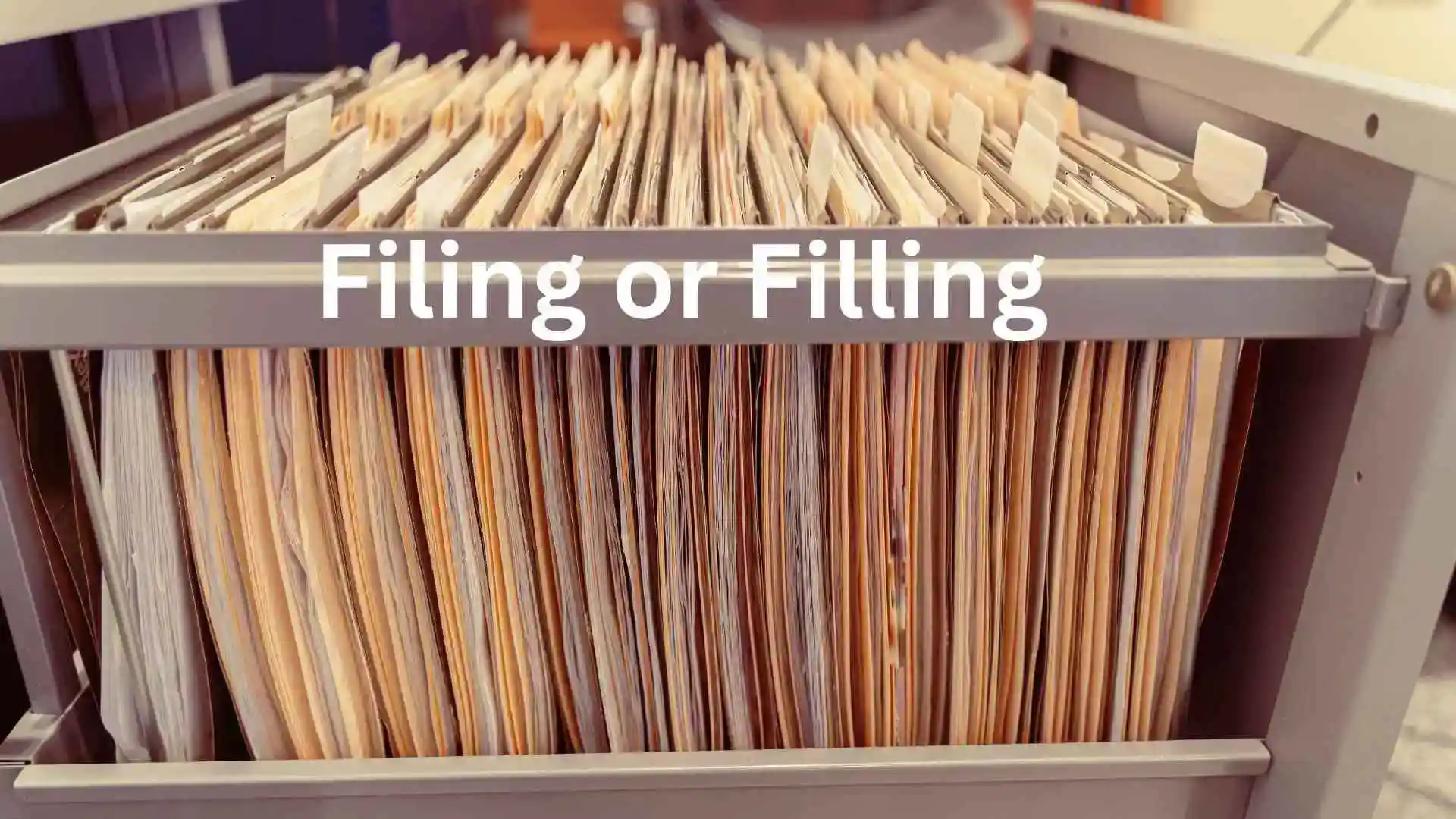
Filing or filling is a common English spelling confusion because both words look similar, sound somewhat alike, and come from closely related-looking verb forms. However, they have completely different meanings.
Filing comes from the verb file. It usually refers to organizing documents, records, or paperwork. It can also mean officially submitting a document to a court, government office, company, or another organization.
Filling comes from the verb fill. It means putting something into an empty space or container, making something full, or completing a form with information.
For example, you might say, “She is filing the documents in the cabinet,” but you would say, “She is filling the bottle with water.”
This guide explains filing or filling in detail, including their meanings, spelling rules, pronunciation, sentence examples, common phrases, form-related usage, legal usage, workplace examples, common mistakes, and an easy memory trick.
Filing or Filling: What Is the Difference?

The main difference between filing or filling comes from their base verbs:
- File → filing
- Fill → filling
Filing generally involves documents, records, paperwork, or official submissions.
Filling generally involves making something full, adding something to an empty space, or completing something such as a form.
Compare these sentences:
The assistant is filing the reports.
The assistant is filling the boxes.
In the first sentence, the assistant is organizing reports. In the second sentence, the assistant is putting something into boxes.
Filing Meaning
Filing is the present participle or gerund form of file.
As a verb, file can mean to arrange documents systematically. It can also mean to submit an official document.
Examples include:
- filing documents
- filing records
- filing paperwork
- filing a complaint
- filing a lawsuit
- filing an appeal
- filing a report
- filing an application
For example:
The office worker is filing the customer records.
Here, filing means organizing the records.
Another example is:
The lawyer is filing a complaint.
Here, filing means formally submitting the complaint.
Filling Meaning
Filling is the present participle or gerund form of fill.
It means putting something into a container, space, or object, usually until it contains the required amount. It can also refer to completing a form.
Examples include:
- filling a bottle
- filling a glass
- filling a box
- filling a tank
- filling a bag
- filling out a form
- filling in a form
- filling a gap
For example:
She is filling the glass with water.
The action involves putting water into the glass.
Another example is:
He is filling out a job application.
Here, filling out means entering the requested information.
When to Use Filing
Use filing when the action involves organizing, storing, or formally submitting documents.
Filing Documents
One of the most common uses of filing is organizing documents.
The secretary is filing the documents alphabetically.
The documents are being placed into an organized filing system.
Other examples include:
I spent the afternoon filing old records.
She is filing the invoices in the correct folder.
The clerk is responsible for filing important paperwork.
Filing Official Documents
Filing can also mean officially submitting documents.
The company is filing its annual report.
The attorney is filing the required legal documents.
She is filing an application with the relevant office.
The exact meaning depends on the context, but the common idea is that a document is being formally handled or submitted.
Filing a Complaint
The phrase filing a complaint is especially common.
The customer decided to file a complaint.
This means the customer is formally submitting a complaint.
The same structure appears in many formal contexts:
- file a complaint
- file a claim
- file an appeal
- file a petition
- file a lawsuit
- file a report
The -ing form of these expressions is:
- filing a complaint
- filing a claim
- filing an appeal
- filing a petition
- filing a lawsuit
- filing a report
When to Use Filling
Use filling when something is being made full or when something is being added to an empty space.
Filling a Container
This is one of the easiest uses to recognize.
She is filling the bottle with water.
He is filling the tank with fuel.
They are filling the boxes with books.
The waiter is filling the glasses.
In each sentence, something is being added to a container.
Filling a Space
Filling can also describe putting something into an empty area.
The workers are filling the hole with soil.
The boxes are filling the empty space.
She used flowers for filling the gaps in the arrangement.
The word does not have to refer to a physical container. A gap, space, position, or other absence can also be filled.
Filling Out a Form
Another extremely common expression is filling out a form.
Please fill out the application.
She is filling out the registration form.
I need to fill out this document before the appointment.
Here, filling out means completing the form by entering the required information.
Filing or Filling a Form
The difference becomes especially important when talking about forms.
Filling Out a Form
Use filling out a form when you mean completing it with information.
Please fill out the application form.
He is filling out the registration form.
I spent twenty minutes filling out the paperwork.
In British English, fill in a form is also widely used.
Please fill in this form.
Both expressions describe the act of completing a form.
Filing a Form
Filing a form has a different meaning. It can refer to officially submitting a form to an authority or organization.
The business is filing the required form with the government office.
The distinction can be remembered this way:
Filling out a form means completing the information.
Filing a form means formally submitting the completed document in a context where that terminology applies.
Filing or Filling Documents
Both words can occur with documents, but they describe different actions.
Filing Documents
Filing documents usually means organizing, storing, or formally submitting them.
The assistant is filing the documents in the cabinet.
The company has a system for filing employee records.
Filling Out Documents
Filling out documents means completing them with information.
The applicant is filling out the required documents.
She spent the morning filling out employment paperwork.
If your intended meaning is completing information, filling out is usually the appropriate expression.
If your intended meaning is organizing documents or formally submitting them, filing is generally appropriate.
Filing or Filling Paperwork
The same distinction applies to paperwork.
Filing Paperwork
The employee is filing the paperwork.
This suggests that the paperwork is being organized or handled as part of a record-keeping system.
Filling Out Paperwork
The employee is filling out the paperwork.
This means the employee is completing the paperwork by entering the necessary information.
This distinction is useful in offices, schools, banks, hospitals, government departments, and businesses.
Filing or Filling a Complaint
When you mean formally submitting a complaint, the standard expression is filing a complaint.
The customer is filing a complaint with the company.
She is filing a complaint against the landlord.
The employee is filing a formal complaint with the department.
Filling a complaint would normally be incorrect if you mean formally submitting one.
The word filing is used because the complaint is being formally recorded or submitted.
Filing or Filling in Legal English
Legal English frequently uses filing because courts or legal authorities receive documents through formal filing procedures.
Common expressions include:
- filing a lawsuit
- filing a complaint
- filing an appeal
- filing a petition
- filing a motion
- filing a claim
- filing court documents
- filing a legal notice
Examples:
The attorney is filing an appeal.
The plaintiff is filing a lawsuit.
The lawyer is filing a motion with the court.
In these examples, filing refers to an official legal submission.
Filing or Filling in Business English

Both words are useful in professional communication.
Filing commonly appears when discussing:
- records
- invoices
- reports
- contracts
- tax documents
- employee files
- applications
- legal paperwork
Examples:
The accountant is filing the tax documents.
The assistant is filing the invoices.
The manager is responsible for filing company records.
Filling commonly appears when discussing:
- forms
- applications
- containers
- spaces
- orders
- information
Examples:
The employee is filling out the application.
The worker is filling the boxes.
She is filling the empty positions on the schedule.
Filing or Filling: Spelling Rules
The spelling difference comes from the base verbs.
File Becomes Filing
The verb file ends in a silent e.
When -ing is added, the final e is removed:
file + ing = filing
This follows a common English spelling pattern.
Other examples include:
- make → making
- write → writing
- take → taking
- drive → driving
- use → using
Therefore, filing is spelled with one l.
Fill Becomes Filling
The verb fill already ends in two ls.
When -ing is added:
fill + ing = filling
Therefore, filling keeps the two ls.
Other words with similar spelling patterns include:
- spill → spilling
- control → controlling
- travel → travelling or traveling, depending on the variety of English
For file or fill, the important forms are:
file → filing
fill → filling
Filing or Filling Pronunciation
Although filing or filling can sound similar to some learners, they have different pronunciations.
Filing sounds approximately like:
“FYE-ling”
Filling sounds approximately like:
“FILL-ing”
The vowel sound is the main difference.
A useful way to practice them is to say the base verbs first:
file → filing
fill → filling
When you connect each word to its base verb, the spelling becomes easier to remember.
Filing or Filling Examples
Here are practical examples showing the difference.
Examples of Filing
- She is filing the reports.
- He is filing the documents.
- The assistant is filing customer records.
- The lawyer is filing a complaint.
- The company is filing its tax documents.
- We are filing the invoices.
- She is filing an appeal.
- The clerk is filing the paperwork.
- He spent the morning filing old records.
- The office has a new system for filing documents.
Examples of Filling
- She is filling the bottle.
- He is filling the glass with water.
- They are filling the boxes with books.
- The worker is filling the tank.
- I am filling out the application.
- She is filling in the form.
- They are filling the empty space.
- He is filling the bags with groceries.
- The children are filling the containers.
- The workers are filling the hole with soil.
Filing or Filling: Common Mistakes
Mistake 1: “Filing the Bottle”
Incorrect:
She is filing the bottle with water.
Correct:
She is filling the bottle with water.
The bottle is being made full, so filling is correct.
Mistake 2: “Filling the Documents in the Cabinet”
If you mean organizing documents in a cabinet, use filing.
Correct:
She is filing the documents in the cabinet.
Mistake 3: “Filing Out a Form”
Incorrect:
Please file out this form.
Correct:
Please fill out this form.
The expression for completing a form is fill out.
Mistake 4: “Filling a Complaint”
If you mean formally submitting a complaint, use:
filing a complaint
Example:
The customer is filing a complaint with the company.
Mistake 5: Confusing the Base Verbs
A simple way to avoid mistakes is to identify the base verb.
If the base verb is file, the -ing form is filing.
If the base verb is fill, the -ing form is filling.
Filing or Filling: Quick Comparison

| Word | Base Verb | Main Meaning | Example |
|---|---|---|---|
| Filing | File | Organizing or submitting documents | She is filing the records. |
| Filling | Fill | Making something full | She is filling the bottle. |
| Filing | File | Official submission | He is filing a complaint. |
| Filling | Fill | Completing information | She is filling out the form. |
How to Remember Filing or Filling
The easiest memory trick is to connect each word with its base verb.
Think:
FILE = documents
A file cabinet contains documents. If you are organizing those documents, you are filing them.
Then remember:
FILL = make full
If you are adding water to a bottle, you are filling it. If you are entering information on a form, you are filling out the form.
A simple memory formula is:
File → Filing → Documents
Fill → Filling → Make full
This method is useful because it focuses on meaning rather than memorizing spelling alone.
Frequently Asked Questions
Is filing or filling correct?
Both filing or filling are correct words, but they have different meanings. Filing comes from file and usually relates to documents, records, or official submissions. Filling comes from fill and usually means making something full or completing something.
Is it filing out or filling out?
The correct phrase is filling out.
Example:
Please fill out the application.
Is it filing a form or filling out a form?
Filling out a form means completing it with the requested information. Filing a form can mean formally submitting it to an organization or authority.
Is filing spelled with one L?
Yes. Filing is spelled with one l after the fi:
F-I-L-I-N-G
It comes from file.
Is filling spelled with two Ls?
Yes. Filling is spelled with two ls:
F-I-L-L-I-N-G
It comes from fill.
What does filing mean?
Filing generally means organizing, storing, or formally submitting documents or records.
What does filling mean?
Filling means putting something into a space or container, making something full, or completing something such as a form.
Is “filling a form” correct?
When you mean completing a form, filling out a form or filling in a form is the usual expression. Filing a form has a different meaning related to formal submission.
Is “filing paperwork” correct?
Yes. Filing paperwork is correct when you mean organizing or formally submitting paperwork.
Is “filling out paperwork” correct?
Yes. Filling out paperwork means completing paperwork by providing the required information.
Is “filing a complaint” correct?
Yes. Filing a complaint means formally submitting a complaint to an organization, authority, or other relevant body.
How can I easily remember the difference?
Remember file → filing for documents or records. Remember fill → filling for making something full or completing a form.
Conclusion
Understanding filing or filling becomes much easier when you remember their base verbs.
Filing comes from file. It is commonly used for organizing documents, keeping records, or formally submitting paperwork. You can file documents, file a report, or file a complaint.
Filling comes from fill. It means making something full, putting something into a space, or completing information. You can fill a bottle, fill a box, or fill out a form.
The simplest rule is:
File → filing → documents or official submissions
Fill → filling → making something full or completing something
Once you connect each word with its meaning, choosing the correct spelling becomes much easier. This distinction is especially useful in professional, academic, legal, and everyday English.

I am Eleanor Whitmore, an education writer who enjoys making learning simple, practical, and interesting. I write about study skills, educational ideas, personal growth, and useful knowledge that readers can apply in everyday life. Through Teachlora, I aim to share clear and helpful content that makes learning feel easier and more enjoyable. My books, The Everyday Learning Guide and Small Steps to Smarter Learning, reflect my passion for helping readers build better learning habits.
Books:
- The Everyday Learning Guide
- Small Steps to Smarter Learning
 Clara Kensington