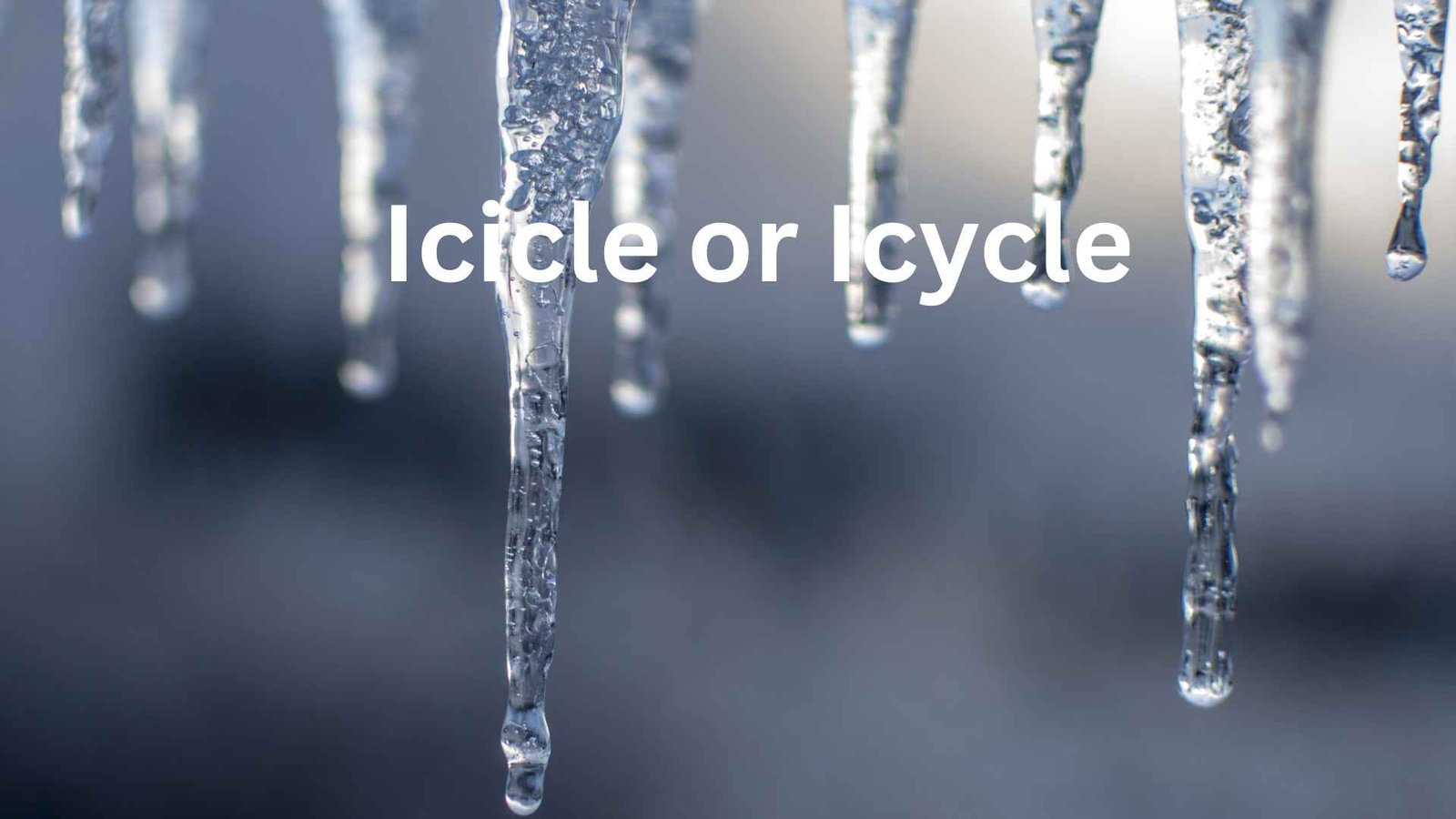
If you are searching for “icicle or icycle,” you are probably trying to determine the correct spelling before using the word in your writing. The answer is straightforward: icicle is the correct spelling. Icycle is a common misspelling when referring to a pointed piece of ice.
An icicle is a pointed piece of ice that forms when dripping or melting water freezes, often along roofs, gutters, tree branches, windows, or other surfaces during cold weather.
The confusion usually comes from pronunciation. Icicle is commonly pronounced approximately like “EYE-si-kul,” so some people assume that the spelling should contain a y. However, standard English uses icicle.
This guide explains icicle or icycle in detail, including the correct spelling, meaning, pronunciation, plural form, sentence examples, common mistakes, and frequently asked questions. It also addresses the search intent behind this spelling query so readers can quickly find the information they need.
Icicle or Icycle: Which Is Correct?
The correct spelling is icicle.
Icycle is incorrect when you are referring to a pointed piece of ice that forms as water freezes.
| Spelling | Correct? | Meaning |
|---|---|---|
| Icicle | Yes | A pointed piece of ice |
| Icycle | No | A common misspelling of icicle |
If you need to use this word in an essay, school assignment, article, email, story, or professional document, choose icicle.
The Correct Spelling Is Icicle
The correct spelling is:
I-C-I-C-L-E
The word contains six letters and ends with -icle.
For example:
A large icicle was hanging from the roof.
The incorrect form would be:
A large icycle was hanging from the roof.
The second sentence contains the spelling mistake.
Is Icycle a Correct Spelling?
No. Icycle is not the standard spelling for a pointed piece of ice.
If you see icycle used in a sentence where the writer means a frozen formation hanging from a roof, branch, or another surface, it should normally be corrected to icicle.
The easiest way to remember the correct form is:
Icicle or icycle? Choose icicle.
What Does Icicle Mean?

An icicle is a pointed piece of ice that develops when water drips or freezes in cold conditions.
Icicles are often seen during winter. For example, snow on a roof can partially melt when the temperature changes. The water may run toward the edge of the roof and drip downward. If the surrounding temperature is below freezing, the water can freeze and gradually form a pointed piece of ice.
That frozen formation is called an icicle.
Simple Definition of Icicle
A simple definition is:
An icicle is a pointed piece of ice formed when dripping water freezes.
The word usually describes ice that hangs downward from a surface.
What Does Icicle Mean in Simple English?
In simple English, an icicle is a long or pointed piece of ice that hangs from something.
For example:
An icicle was hanging from the roof.
This means a piece of frozen water had formed and was hanging from the edge of the roof.
Why Is Icicle Often Misspelled as Icycle?
The main reason for the confusion is pronunciation.
The word icicle is commonly pronounced approximately:
EYE-si-kul
The first sound resembles the word eye, which may cause someone to guess that the word should contain a y.
That can lead to the incorrect spelling:
icycle
instead of the correct spelling:
icicle
English spelling can be difficult because pronunciation does not always tell you exactly which letters to use. The written form of a word must often be learned separately from its pronunciation.
Pronunciation Can Cause the Confusion
When someone hears icicle without seeing it written, they may try to spell the word based on its sound.
They may think:
“It sounds like eye-si-kul, so perhaps it starts with icy.”
However, the standard spelling is icicle, not icycle.
The pronunciation may sound different from the way the word looks on the page, so remembering the written form is important.
How to Remember the Correct Spelling
A useful memory trick is to focus on the spelling:
ICICLE
You can also connect the word with ice, because an icicle is made of ice.
Another simple reminder is:
Icicle has “icle,” not “ycle.”
If you are choosing between icicle or icycle, choose icicle.
How Do You Spell Icicle?
The word is spelled:
I-C-I-C-L-E
The complete word is:
icicle
It should not be spelled icycle.
Letter-by-Letter Spelling
You can break the spelling down like this:
I + C + I + C + L + E
This produces:
ICICLE
Learning the visual pattern can make it easier to recognize the correct spelling when writing.
Common Misspellings of Icicle
Some incorrect forms may appear because people are trying to spell the word based on pronunciation.
Common mistakes include:
- icycle
- icikle
- icical
- icicel
- iciclee
The standard English spelling is:
icicle
If you are proofreading an article or assignment, icycle should be corrected when it is intended to mean a pointed piece of ice.
How Do You Pronounce Icicle?
Icicle is commonly pronounced approximately EYE-si-kul.
The first syllable sounds like the word eye, followed by a sound similar to “si,” then “kul.”
The pronunciation is one reason the spelling can be confusing for learners or other writers.
Icicle Pronunciation or Spelling
When learning the word, keep these two pieces of information separate:
Pronunciation: EYE-si-kul
Spelling: icicle
Do not change the spelling to icycle simply because the first sound resembles “eye.”
English contains many words where pronunciation does not provide a perfect guide to spelling. Icicle is one example where remembering the written form is especially useful.
What Is the Plural of Icicle?

The plural of icicle is icicles.
To make the plural, add s to the singular form:
icicle → icicles
Singular Form
Use icicle when you are talking about one.
A long icicle hung from the roof.
Plural Form
Use icicles when you are talking about two or more.
Several icicles were hanging from the roof.
The plural spelling is straightforward:
ICICLES
It does not become icycles.
Icicle in a Sentence
Seeing the correct word in context can make its spelling and meaning easier to understand.
Here are several examples:
- A large icicle was hanging from the edge of the roof.
- The warm sunlight caused the icicle to melt.
- We saw several icicles hanging from the trees.
- The children were fascinated by the sparkling icicles.
- An icicle formed near the window during the freezing weather.
- The cabin was surrounded by snow with long icicles hanging from the roof.
- A small icicle developed on the gutter overnight.
- The falling icicle broke into several pieces when it hit the ground.
These examples show how icicle works naturally as a noun.
What Is an Icicle Made Of?
An icicle is made of ice, which is frozen water.
The formation usually begins with liquid water. When water drips or flows in freezing conditions, it can freeze. Additional water may freeze onto the existing ice, gradually creating a larger formation.
The result can be a long, narrow, pointed piece of ice.
How Do Icicles Form?
Icicles commonly form through repeated cycles of melting or freezing.
For example, imagine snow covering a roof. During a period of slightly warmer weather, some of the snow may melt. The resulting water moves toward the roof’s edge and begins to drip.
If the air is cold enough, the water freezes. More water can then freeze onto the existing ice, causing the formation to grow.
Over time, this process can create an icicle.
Where Are Icicles Commonly Found?
Icicles can form on many surfaces, including:
- Roof edges
- Gutters
- Tree branches
- Window frames
- Fences
- Cliffs
- Shelters
- Other exposed surfaces
Roofs or gutters are especially familiar places to see icicles during freezing weather.
Icicle or Ice: What Is the Difference?
Although ice or icicle are closely related, they do not mean exactly the same thing.
Ice is the general term for frozen water.
An icicle is a particular formation of ice, usually pointed and hanging from a surface.
Consider these examples:
The lake was covered with ice.
This sentence refers to frozen water across the lake.
A long icicle hung from the roof.
This sentence refers to a specific pointed piece of ice.
Therefore, an icicle is made of ice, but not every piece of ice is an icicle.
Icicle or Icycle: Key Difference
The difference between icicle or icycle is mainly a matter of correct or incorrect spelling.
Icicle
Icicle is the standard English word.
Example:
The icicle grew longer overnight.
Icycle
Icycle is a common misspelling of icicle when someone means a frozen piece of ice.
Example:
The icycle grew longer overnight.
In standard writing, this should be corrected to:
The icicle grew longer overnight.
Is Icicle a Noun?
Yes. Icicle is a noun.
A noun is a word used to name a person, place, thing, or idea. Because an icicle is a physical object, icicle functions as a noun.
For example:
The icicle melted.
In this sentence, icicle is the noun.
The plural form is also a noun:
The icicles melted.
Common Uses of the Word Icicle
The word icicle is commonly used in descriptions of winter weather or frozen environments.
You may see it in:
- Weather writing
- Winter stories
- School assignments
- Nature descriptions
- Children’s books
- Travel articles
- Poems
- Everyday conversation
- Safety information
For example:
The old cabin looked beautiful with snow-covered branches and icicles hanging from the roof.
Here, icicles helps describe the winter scene.
Are Icicles Dangerous?
Icicles can sometimes pose a safety risk, especially when they become large or form above areas where people walk.
A large icicle can break away from a roof or other surface and fall. For this reason, people should be cautious around large icicles and avoid standing directly underneath them.
The word therefore appears not only in descriptions of winter scenery but also in discussions about cold-weather safety.
Icicle Examples for Students
Students may need to use icicle in sentences, stories, assignments, or vocabulary exercises.
Here are some simple examples:
The icicle hung from the roof.
A small icicle formed outside the window.
The icicles began to melt in the sunlight.
We saw beautiful icicles on the trees.
The cold weather created a large icicle.
These examples use the word in clear and natural contexts.
A Short Paragraph Using Icicle
The temperature dropped during the night, and by morning, several icicles had formed along the roof. Sunlight made the frozen formations sparkle. As the day became warmer, the icicles slowly began to melt.
This paragraph demonstrates the singular or plural forms of the word.
Reader Intent Behind “Icicle or Icycle”
The keyword “icicle or icycle” has clear spelling intent.
Most people who search this phrase are likely trying to determine which form is correct before using it in writing. They may have encountered the word in conversation, heard it pronounced, or seen both spellings online.
A helpful article should therefore provide the answer near the beginning instead of making readers search through several paragraphs.
The primary answer is:
Icicle is correct. Icycle is incorrect.
After answering the primary question, readers may want supporting information such as the word’s meaning, pronunciation, plural form, examples, or explanation of the spelling confusion.
Why Search Intent Matters
Search intent refers to what a person actually wants to accomplish when they type a query into a search engine.
For “icicle or icycle,” the primary intent is to determine the correct spelling.
The secondary intent may include:
- Understanding the definition
- Learning pronunciation
- Checking the plural
- Finding sentence examples
- Understanding the spelling mistake
- Learning how the word is used
- Confirming whether icycle is a standard spelling
A useful article should address these needs naturally without adding unrelated information.
How to Make the Answer Easy to Find
For a spelling comparison, clarity is important.
The answer should be visible early:
Icicle is the correct spelling.
A comparison table can also help readers quickly understand the difference.
Additional sections can then answer related questions without repeating the same sentence unnecessarily.
This creates content that is useful for readers who need a quick answer or readers who want a more complete explanation.
Related Questions People May Ask
Readers searching for icicle or icycle may also search for related questions, such as:
- How do you spell icicle?
- Is icycle a word?
- What does icicle mean?
- How do you pronounce icicle?
- What is the plural of icicle?
- How do you use icicle in a sentence?
- What is an icicle made of?
- Where do icicles form?
- Is icicle a noun?
- What is the difference between ice or icicle?
Covering these closely related questions makes the article more useful because readers can find the information they need in one place.
Frequently Asked Questions
Is Icicle or Icycle Correct?
Icicle is the correct spelling for a pointed piece of ice that forms when water freezes. Icycle is a common misspelling.
Is Icycle a Word?
Icycle is not the standard spelling of the word meaning a pointed piece of hanging ice. The correct form is icicle.
What Does Icicle Mean?
An icicle is a pointed piece of ice that forms when dripping or melting water freezes, often on roofs, branches, gutters, or other surfaces.
How Do You Spell Icicle?
The correct spelling is I-C-I-C-L-E, or icicle.
How Do You Pronounce Icicle?
Icicle is commonly pronounced approximately EYE-si-kul.
What Is the Plural of Icicle?
The plural of icicle is icicles.
Example:
The roof was covered with icicles.
Is Icicle a Noun?
Yes. Icicle is a noun because it names a physical object.
Why Do People Spell Icicle as Icycle?
The spelling mistake may come from pronunciation. Icicle sounds approximately like “EYE-si-kul,” which can cause people to incorrectly insert a y when spelling it.
What Is an Icicle Made Of?
An icicle is made of ice, which is frozen water.
Where Do Icicles Form?
Icicles commonly form on roof edges, gutters, tree branches, windows, or other surfaces where water can drip and freeze.
Is Icicle Related to the Word Ice?
Yes. An icicle is a particular formation of ice. The two words are related in meaning, although ice is the broader term.
Can I Use Icycle in a School Assignment?
If you mean a pointed piece of ice, use icicle. The spelling icycle should be avoided in standard English writing.
Or Reader-Focused Content Considerations
A spelling article should be written primarily for the person asking the question. For this keyword, readers generally do not need a long technical discussion before receiving the answer.
The most useful approach is to:
- Give the correct spelling immediately.
- Clearly identify the incorrect spelling.
- Explain the meaning.
- Show the word in sentences.
- Include pronunciation.
- Explain the plural form.
- Address the reason for the common mistake.
- Answer closely related questions.
- Keep the information focused on the original query.
- Use natural variations instead of excessive keyword repetition.
This helps create content that serves the reader’s actual purpose rather than simply repeating “icicle or icycle” throughout the content.
Semantic coverage can naturally include terms such as correct spelling, icicle meaning, icicle pronunciation, plural of icicle, spelling mistake, piece of ice, frozen water, winter weather, and sentence examples. These terms are relevant because they help explain the topic rather than being added simply for keyword density.
Icicle or Icycle: Final Answer
The correct spelling is icicle.
Icycle is a common misspelling when referring to a pointed piece of ice.
An icicle is a pointed formation of ice that develops when dripping or melting water freezes. Icicles commonly appear on roofs, gutters, tree branches, windows, and other surfaces during cold weather.

I am Eleanor Whitmore, an education writer who enjoys making learning simple, practical, and interesting. I write about study skills, educational ideas, personal growth, and useful knowledge that readers can apply in everyday life. Through Teachlora, I aim to share clear and helpful content that makes learning feel easier and more enjoyable. My books, The Everyday Learning Guide and Small Steps to Smarter Learning, reflect my passion for helping readers build better learning habits.
Books:
- The Everyday Learning Guide
- Small Steps to Smarter Learning
 Clara Kensington