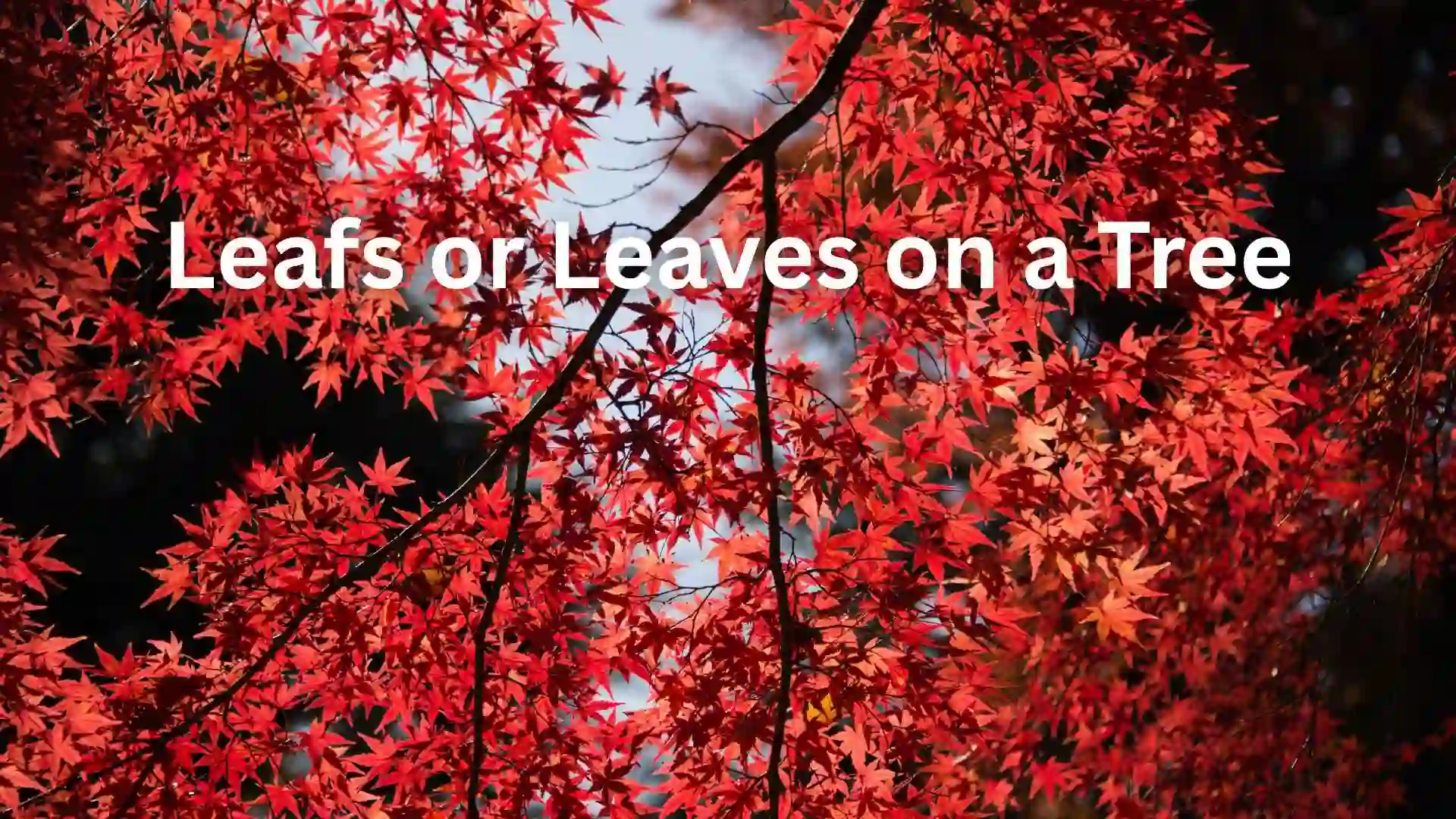
Leafs or leaves on a tree? The correct word is leaves when talking about the green parts of a tree or plant. Leaves is the plural form of leaf, while leafs is not the standard plural spelling for tree foliage.
For example, “The leaves on the tree are green” is correct, but “The leafs on the tree are green” is incorrect.
This spelling difference can confuse English learners because most nouns become plural by adding -s or -es. However, some English words follow a different rule. When leaf becomes plural, the final f changes to v, followed by -es.
Although leafs has a few valid uses, it is not the correct choice when describing multiple leaves on trees.
This guide explains the difference between leafs or leaves, their meanings, pronunciation, grammar rules, common mistakes, and real-life examples. You’ll also learn when each spelling is appropriate and how to remember the correct plural form.
Leafs or Leaves on a Tree: Quick Answer
Leaves is the correct plural of leaf when referring to trees, plants, or foliage.
A leaf is one of the flat or needle-like structures that grow from a plant’s stem or branches. When there is more than one leaf, the correct word is leaves.
For example:
- Correct: The leaves on the tree are beautiful.
- Incorrect: The leafs on the tree are beautiful.
- Correct: Several leaves fell from the branches.
- Incorrect: Several leafs fell from the branches.
The easiest way to remember the spelling is:
One leaf → Two leaves → Many leaves
Quick Comparison of Leafs or Leaves
| Word | Meaning | Correct Usage |
|---|---|---|
| Leaf | One leaf on a plant or tree | A leaf fell from the tree. |
| Leaves | More than one leaf | The leaves are falling. |
| Leafs | A verb form or part of a proper name | She leafs through a magazine. |
| Leaf’s | Singular possessive form | The leaf’s surface is smooth. |
| Leaves’ | Plural possessive form | The leaves’ colors are changing. |
When writing about nature, gardening, trees, or autumn, use leaves whenever you mean more than one leaf.
What Is the Difference Between Leafs or Leaves?
The difference between leafs or leaves comes from their grammatical functions.
Leaves is the standard plural noun for the structures growing on plants. Leafs is mainly used as a verb form or in certain proper names.
Meaning of Leaf
A leaf is a plant structure that usually grows from a stem or branch. Many leaves contain chlorophyll, which helps plants absorb sunlight for photosynthesis.
The word leaf is singular, meaning it refers to one leaf.
Examples:
- A green leaf is growing on the branch.
- One leaf fell onto the sidewalk.
- The butterfly landed on a leaf.
- A yellow leaf floated in the water.
- The leaf has a smooth surface.
Use leaf when talking about one individual leaf.
Meaning of Leaves
Leaves is the plural noun form of leaf. It refers to two or more leaves.
Examples:
- The leaves are turning yellow.
- Many leaves cover the garden.
- The leaves move gently in the wind.
- Oak trees have distinctive leaves.
- The leaves provide shade during summer.
The word leaves also functions as a verb.
For example:
- She leaves home at seven.
- He leaves the office after work.
- The bus leaves at noon.
In these sentences, leaves comes from the verb leave, meaning to depart.
Meaning of Leafs
The word leafs is not the standard plural of leaf, but it can be grammatically correct in specific situations.
As a verb, leafs means turning the pages of a book, newspaper, or magazine.
Examples:
- He leafs through the newspaper every morning.
- She leafs through an old photo album.
- The student leafs through his textbook.
The spelling also appears in proper names, including the Toronto Maple Leafs hockey team.
However, these uses do not make leafs correct when referring to multiple leaves growing on a tree.
Why Is the Plural of Leaf Leaves Instead of Leafs?
The plural of leaf is leaves because it follows a traditional English spelling pattern.
Some nouns ending in -f or -fe change their endings to -ves when becoming plural.
For leaf, the transformation is:
Leaf → Remove f → Add ves → Leaves
This spelling pattern developed through the history of English and is still used in many common words.
English Words That Change F to Ves
| Singular | Plural |
|---|---|
| Leaf | Leaves |
| Wolf | Wolves |
| Knife | Knives |
| Wife | Wives |
| Life | Lives |
| Shelf | Shelves |
| Thief | Thieves |
| Half | Halves |
| Calf | Calves |
| Loaf | Loaves |
Examples:
- One wolf was howling. Several wolves were howling.
- A knife is on the table. Three knives are on the table.
- One leaf fell. Many leaves fell.
These examples show how the spelling changes when the nouns become plural.
Do All Words Ending in F Follow This Rule?
No. Not every English noun ending in -f changes to -ves.
Some nouns simply add -s.
| Singular | Plural |
|---|---|
| Roof | Roofs |
| Chief | Chiefs |
| Cliff | Cliffs |
| Belief | Beliefs |
| Proof | Proofs |
| Safe | Safes |
Other words, such as scarf or hoof, can have more than one accepted plural form.
Therefore, the safest approach is to learn the standard plural spelling of each word.
For leaf, the standard plural is always leaves when referring to plant foliage.
Is It Leaves on a Tree or Leafs on a Tree?
The correct expression is leaves on a tree.
The word leaves describes the structures growing from a tree’s branches.
Correct examples:
- The leaves on the tree are green.
- The leaves on the tree are turning brown.
- The leaves on the tree look beautiful.
- The leaves on the tree are moving in the breeze.
- The leaves on the tree provide shade.
Incorrect examples:
- The leafs on the tree are green.
- The leafs on the tree are falling.
- The leafs on the tree look beautiful.
In every incorrect sentence, replacing leafs with leaves fixes the spelling.
Leaves on a Tree or Leaves in a Tree?
Both expressions are grammatically possible, but they emphasize slightly different ideas.
Leaves on a tree refers to leaves growing on or attached to the tree.
Example:
“The leaves on the tree are changing color.”
Leaves in a tree emphasizes the location of leaves within the tree’s branches or canopy.
Example:
“The leaves in the tree rustled during the storm.”
When describing a tree’s foliage in general, leaves on a tree is usually the more natural expression.
Leaves on the Tree or Leaves of the Tree?
Both phrases are correct.
Leaves on the tree emphasizes where the leaves are located.
Example:
“The leaves on the tree are bright green.”
Leaves of the tree emphasizes that the leaves belong to a particular tree.
Example:
“The leaves of the tree have a distinctive shape.”
The second expression often appears in scientific descriptions, educational writing, or formal explanations.
Leaf or Leaves: Understanding Singular and Plural
Choosing between leaf or leaves depends on how many leaves you are describing.
When to Use Leaf
Use leaf when referring to one leaf.
Examples:
- A leaf fell from the tree.
- This leaf is yellow.
- One leaf remained on the branch.
- The leaf looks fresh.
- Each leaf has a unique pattern of veins.
Words such as a, one, this, and each commonly appear with singular countable nouns.
When to Use Leaves
Use leaves when referring to more than one leaf.
Examples:
- The leaves are green.
- These leaves are large.
- Five leaves fell from the tree.
- Many leaves covered the ground.
- Several leaves were damaged by insects.
Words such as many, several, these, and those commonly appear with plural nouns.
Singular or Plural Sentence Comparison
| Singular Sentence | Plural Sentence |
|---|---|
| A leaf is green. | The leaves are green. |
| One leaf is falling. | Several leaves are falling. |
| This leaf is dry. | These leaves are dry. |
| That leaf is yellow. | Those leaves are yellow. |
| The leaf looks healthy. | The leaves look healthy. |
| One leaf has fallen. | Many leaves have fallen. |
Notice how the verbs change according to the number of leaves.
For example, leaf usually takes is, while leaves takes are in the present tense of the verb be.
How to Pronounce Leaf or Leaves Correctly
The pronunciation changes when leaf becomes leaves.
Leaf: /liːf/
Leaves: /liːvz/
The singular word leaf ends with an f sound.
The plural word leaves ends with a vz sound.
Pronunciation Examples
- Leaf: One green leaf.
- Leaves: Many green leaves.
- Leaf: A leaf is falling.
- Leaves: The leaves are falling.
A simple way to remember the pronunciation is:
Leaf sounds like “leef.”
Leaves sounds like “leevz.”
The same sound change occurs in several related plural forms.
Examples:
- Wife → Wives
- Knife → Knives
- Wolf → Wolves
- Leaf → Leaves
Learning these pronunciation patterns can improve both spoken English and spelling accuracy.
When Is Leafs Actually Correct?
Although leafs is incorrect as the ordinary plural of leaf, it has legitimate uses in English.
Leafs as a Verb
The verb leaf can mean to turn pages, especially while looking through a book or magazine.
In the third-person singular present tense, the verb becomes leafs.
Examples:
- She leafs through a magazine.
- He leafs through the newspaper.
- The teacher leafs through the textbook.
- My grandfather leafs through old photographs.
The expression leaf through usually suggests turning pages casually or quickly.
Leafs in the Toronto Maple Leafs
The spelling Leafs appears in the official name of the Toronto Maple Leafs, a professional ice hockey team based in Toronto, Canada.
Examples:
- The Toronto Maple Leafs have many fans.
- He watches the Maple Leafs play hockey.
- The Leafs won their game.
The team name is a proper noun, so its established spelling is preserved.
Maple Leafs or Maple Leaves?
The correct spelling depends on what you mean.
Maple leaves refers to the leaves growing on maple trees.
Example:
“The maple leaves turn red during autumn.”
Maple Leafs refers to the hockey team.
Example:
“The Toronto Maple Leafs played an exciting game.”
This distinction is important because the two expressions have different meanings.
Leaf’s or Leaves’: Understanding Possessive Forms
Another common grammar problem involves leaf’s or leaves’.
These forms show possession, but they are used differently.
Leaf’s: Singular Possessive
Use leaf’s when referring to something belonging to one leaf.
Examples:
- The leaf’s surface is smooth.
- The leaf’s color is changing.
- The leaf’s edges are damaged.
- The leaf’s veins are clearly visible.
The apostrophe comes before s because the noun is singular.
Leaves’: Plural Possessive
Use leaves’ when referring to something belonging to multiple leaves.
Examples:
- The leaves’ colors are changing.
- The leaves’ surfaces are wet.
- The leaves’ edges have turned brown.
- The leaves’ shapes vary between trees.
The apostrophe comes after s because leaves is already plural.
Leaf, Leaves, Leaf’s, or Leaves’
| Word | Grammar Function | Example |
|---|---|---|
| Leaf | Singular noun | The leaf is green. |
| Leaves | Plural noun | The leaves are green. |
| Leaf’s | Singular possessive | The leaf’s color is bright. |
| Leaves’ | Plural possessive | The leaves’ colors are beautiful. |
Important: Never use an apostrophe simply to make leaf plural.
Leaves on a Tree in Different Seasons
The word leaves is commonly used when describing how trees change throughout the year.
Leaves in Spring
During spring, many deciduous trees produce new leaves as temperatures rise and growing conditions improve.
Examples:
- Fresh green leaves appear on the branches.
- The young leaves begin to grow.
- Small leaves cover the tree.
- The leaves become larger as spring continues.
Leaves in Summer
During summer, many trees have dense green foliage.
Leaves help plants produce food through photosynthesis and can provide shade.
Examples:
- The leaves provide shade on sunny days.
- Sunlight passes through the green leaves.
- The leaves move gently in the warm breeze.
- The tree has thick, healthy leaves.
Leaves in Autumn
Autumn is often associated with colorful leaves and falling foliage.
In many deciduous trees, chlorophyll breaks down as the growing season ends, allowing other pigments to become more visible.
Examples:
- The leaves turn yellow, orange, and red.
- Dry leaves fall from the branches.
- Colorful leaves cover the sidewalk.
- The falling leaves create a beautiful autumn scene.
Leaves in Winter
Many deciduous trees lose their leaves before winter, while evergreen trees generally retain foliage.
Examples:
- The tree has lost most of its leaves.
- Only a few brown leaves remain.
- The evergreen tree keeps its leaves during winter.
- Fallen leaves cover the frozen ground.
These seasonal examples show how naturally the plural word leaves fits into everyday English.
Common Mistakes With Leafs or Leaves
Even experienced English learners sometimes make mistakes with these words.
Understanding the most common errors can help improve your writing.
Mistake 1: Using Leafs for Tree Foliage
Incorrect: The leafs are falling.
Correct: The leaves are falling.
Explanation: Leaves is the correct plural noun.
Mistake 2: Using Leaves for One Leaf
Incorrect: A leaves fell from the tree.
Correct: A leaf fell from the tree.
Explanation: The article a requires a singular countable noun.
Mistake 3: Using Leaf After a Plural Number
Incorrect: There are ten leaf on the ground.
Correct: There are ten leaves on the ground.
Explanation: Numbers greater than one normally require plural countable nouns.
Mistake 4: Adding an Apostrophe to Make a Plural
Incorrect: The leaf’s are green.
Correct: The leaves are green.
Explanation: Apostrophes do not form regular noun plurals.
Mistake 5: Using the Wrong Verb
Incorrect: The leaves is yellow.
Correct: The leaves are yellow.
Explanation: The plural noun leaves requires the plural verb are.
Mistake 6: Confusing Leave With Leaf
Incorrect: A leave fell from the tree.
Correct: A leaf fell from the tree.
Explanation: Leaf is the singular noun referring to part of a plant. Leave is commonly a verb meaning to depart.
Leaf or Leave: What Is the Difference?
The words leaf and leave look similar but have different meanings.
Leaf is primarily a noun referring to a plant structure.
Leave is commonly a verb meaning to go away, depart, or allow something to remain.
Examples of leaf:
- A leaf fell from the branch.
- The leaf is green.
- An insect landed on the leaf.
Examples of leave:
- I leave home at eight.
- Please leave the door open.
- They leave for school early.
Leaves as a Noun or Verb
The word leaves can be either a noun or a verb.
As a noun:
“The leaves are falling.”
Here, leaves refers to parts of a tree.
As a verb:
“She leaves for work every morning.”
Here, leaves means departs.
You can usually identify the meaning by looking at the surrounding words.
What Are Tree Leaves Called Collectively?
A collection of leaves growing on a tree or plant is commonly called foliage.
Foliage refers to the leafy parts of plants, especially when viewed together.
Examples:
- The tree has thick green foliage.
- Autumn foliage attracts photographers.
- The forest is covered with colorful foliage.
- Dense foliage provides shade.
The word foliage is generally treated as an uncountable noun.
Correct:
“The foliage is beautiful.”
Less natural in ordinary English:
“The foliages are beautiful.”
Other related terms include canopy, which refers to the upper covering formed by branches and foliage, and leaf litter, which describes fallen leaves and other plant material on the ground.
How to Remember Leafs or Leaves Easily
Remembering the correct spelling becomes easier with a few simple methods.
Remember One Leaf, Many Leaves
The most useful rule is:
One leaf → Many leaves
Whenever you describe more than one leaf, use leaves.
Connect Leaf With Similar Words
Think about other nouns that change f to ves.
Examples:
- Wolf → Wolves
- Knife → Knives
- Shelf → Shelves
- Leaf → Leaves
These familiar words can help you remember the pattern.
Practice With Everyday Sentences
Try completing these sentences:
- One green _____ fell from the tree.
- The _____ are turning yellow.
- Five _____ are lying on the ground.
- A small _____ landed on my shoulder.
- The tree has beautiful red _____.
Correct answers:
- Leaf
- Leaves
- Leaves
- Leaf
- Leaves
Regular practice helps you recognize the correct spelling automatically.
Examples of Leaf or Leaves in Sentences
Here are additional sentences to help students, writers, and English learners use the words correctly.
Simple Sentences for Beginners
- A leaf is green.
- The leaves are falling.
- One leaf is yellow.
- Many leaves cover the ground.
- The tree has large leaves.
- This leaf is dry.
- These leaves are fresh.
- A leaf floated in the river.
Descriptive Sentences About Nature
- Golden leaves shimmer in the afternoon sunlight.
- A gentle breeze moves through the leaves.
- The tree’s colorful leaves create a beautiful autumn scene.
- Raindrops sparkle on the leaves after the storm.
- The leaves rustle softly in the evening wind.
- Bright green leaves cover the branches in spring.
Educational Sentences About Leaves
- Leaves help plants make food through photosynthesis.
- Many leaves contain chlorophyll, which gives them their green color.
- Different tree species have different leaf shapes.
- Some trees lose their leaves during autumn.
- Leaves exchange gases with the surrounding air.
- Leaf veins help transport water and nutrients through the leaf.
These examples show how leaf or leaves can be used in simple descriptions, scientific explanations, and everyday conversations.
Frequently Asked Questions About Leafs or Leaves
Is It Leafs or Leaves on a Tree?
The correct expression is leaves on a tree. Leaves is the standard plural of leaf. The spelling leafs is incorrect when referring to multiple leaves growing on trees.
What Is the Correct Plural of Leaf?
The correct plural of leaf is leaves.
Example:
- Singular: One leaf is falling.
- Plural: Several leaves are falling.
Why Is It Leaves Instead of Leafs?
The word leaf follows a traditional English spelling pattern in which some nouns ending in -f change to -ves in the plural. Therefore, leaf becomes leaves.
Is Leafs a Real English Word?
Yes. Leafs exists as a verb form, as in “She leafs through a magazine.” It also appears in proper names such as the Toronto Maple Leafs. However, it is not the standard plural noun for tree foliage.
Is It Tree Leafs or Tree Leaves?
Tree leaves is correct.
Example:
“The tree leaves are changing color.”
You can also say:
“The leaves on the tree are changing color.”
Is It Falling Leafs or Falling Leaves?
The correct phrase is falling leaves.
Example:
“The falling leaves covered the sidewalk.”
This expression is especially common when describing autumn.
Is It Leaves on the Tree or Leaves in the Tree?
Both phrases can be correct. Leaves on the tree emphasizes leaves growing on the tree, while leaves in the tree emphasizes their location within the branches or canopy.
Is It a Leaf or a Leaves?
Use a leaf when referring to one leaf.
Example:
“A leaf fell from the branch.”
Use leaves when referring to more than one.
Example:
“Several leaves fell from the branch.”
Is It Maple Leafs or Maple Leaves?
Both spellings are correct in different contexts.
Maple leaves refers to foliage growing on maple trees.
Maple Leafs refers to the Toronto Maple Leafs hockey team.
What Is the Difference Between Leaf or Leave?
Leaf is a noun referring to a plant structure. Leave is commonly a verb meaning to depart or go away.
Example:
“A leaf fell from the tree.”
“I leave home every morning.”
What Is the Plural of Oak Leaf?
The plural of oak leaf is oak leaves.
Example:
“The oak leaves turned brown in autumn.”
The same rule applies to maple leaves, palm leaves, and other types of tree leaves.
What Is the Plural of Maple Leaf?
The standard plural is maple leaves when referring to the foliage of maple trees.
Example:
“Several maple leaves fell onto the grass.”
What Do You Call Many Leaves on a Tree?
Many leaves growing together on a tree are collectively called foliage.
Example:
“The tree has dense green foliage.”
Do All Trees Have Leaves?
Trees generally have leaves, but their forms vary. Broadleaf trees often have wide, flat leaves, while many conifers have needle-like or scale-like leaves. Some trees lose their foliage seasonally, while others remain evergreen.
How Do You Spell Leaves on a Tree?
The correct spelling is L-E-A-V-E-S.
Example:
“The leaves on the tree are green.”
Remember that the final f in leaf changes to ves in the plural.
Conclusion
When choosing between leafs or leaves on a tree, the correct answer is leaves.
Leaf refers to one leaf, while leaves refers to two or more. The plural follows a traditional English spelling pattern in which some nouns ending in -f change to -ves.
Although leafs can be correct as a verb or part of a proper name, it should not be used as the ordinary plural noun for tree foliage.
You can remember the difference with one simple rule: One leaf, many leaves.
By understanding this rule, you can confidently use leaf or leaves in everyday conversations, school assignments, nature descriptions, and professional writing.

I am Nathaniel Brooks, a writer passionate about education and lifelong learning. I believe good educational content should be easy to understand, useful, and enjoyable to read. At Teachlora, I create helpful articles about learning techniques, study habits, general knowledge, and skills that can support readers in their educational journey. I have also written Learn Better Every Day and The Practical Student Handbook to help readers approach learning with more confidence.
Books:
- Learn Better Every Day
- The Practical Student Handbook
 Oliver Harrington
 Eleanor Whitmore