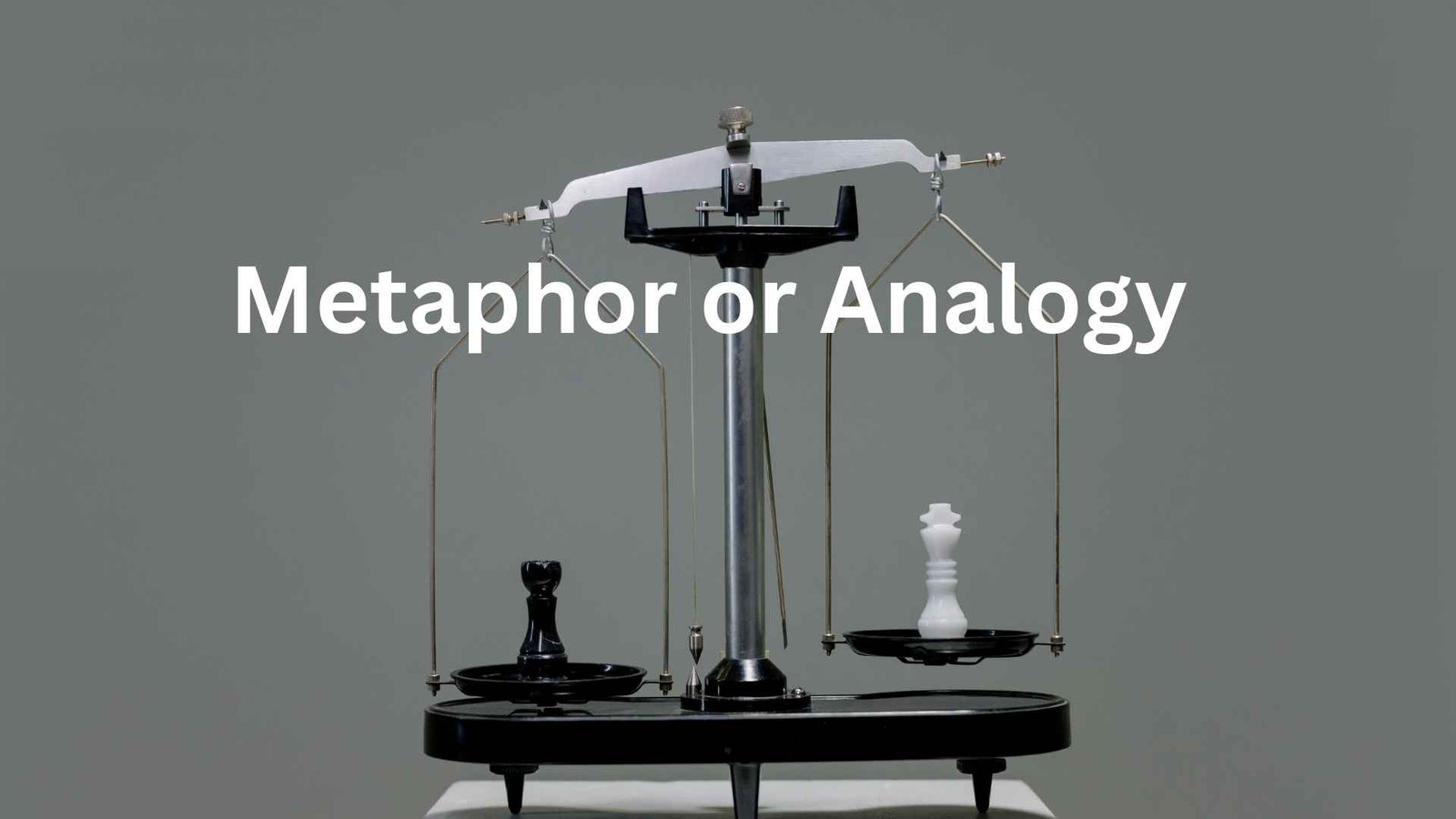
If you are searching for metaphor or analogy, you may want to know what these terms mean, how they differ, and how to identify each one in a sentence. The confusion is understandable because both use comparison to help communicate an idea.
A metaphor usually makes a direct comparison to create a vivid image or express an idea in an imaginative way. An analogy usually uses a comparison to explain a relationship, process, or unfamiliar concept.
For example, “Time is a thief” is a metaphor. Time is not literally a thief. The phrase suggests that time takes valuable moments away.
An analogy can provide a longer explanation: “Learning a new skill is like building a house because it requires a strong foundation, patience, practice, and continued effort.”
The key difference is purpose. A metaphor often helps readers picture or feel an idea, while an analogy usually helps readers understand an idea.
What Is a Metaphor?
A metaphor is a figure of speech that directly describes one thing as another thing. The comparison is not meant literally. Instead, it highlights a particular quality shared by the two subjects.
Consider this example:
“The classroom was a zoo.”
A classroom is not literally a zoo. The metaphor suggests that the classroom was noisy, crowded, chaotic, or difficult to control.
Metaphors are common in literature, everyday speech, advertising, speeches, essays, social media, and creative writing. They can make ordinary descriptions more memorable.
Simple Metaphor Examples
Here are several examples:
- “Her smile was sunshine.”
- “He has a heart of stone.”
- “Life is a journey.”
- “Knowledge is power.”
- “The world is a stage.”
- “His words were weapons.”
- “My mind is a computer.”
- “The city is a jungle.”
Each sentence creates a connection between two different things.
For example, “Her smile was sunshine” suggests that her smile brings warmth, happiness, or comfort. It does not mean that her smile literally produces sunlight.
Why Do Writers Use Metaphors?
Writers use metaphors to make ideas more vivid. An abstract concept can be difficult to picture when it is described only with literal language.
Compare these two sentences:
“She was very nervous.”
“Butterflies filled her stomach.”
The second sentence gives the reader a stronger image of nervousness.
A well-chosen metaphor can also make a sentence easier to remember because it gives the reader something concrete to visualize.
What Is an Analogy?
An analogy is a comparison used to explain an idea by showing how it relates to something familiar.
An analogy can compare two situations, processes, objects, or concepts. The goal is usually to make an unfamiliar idea easier to understand.
For example:
“Learning a new language is like building a bridge because every new word helps you communicate with more people.”
The comparison between language learning and bridge building gives the reader a familiar image for understanding communication.
An analogy can be short or detailed. It often explains several similarities instead of simply creating one imaginative image.
Simple Analogy Examples
Consider these examples:
- “Learning is like exercising because regular practice improves performance.”
- “Building trust is like building a house because both require a strong foundation.”
- “Running a business is like steering a ship because decisions determine its direction.”
- “The brain is like a computer because both process information.”
- “Studying for an exam is like training for a race because preparation improves performance.”
These examples use familiar situations to explain less familiar ideas.
Why Do Writers Use Analogies?
Analogies are especially useful when the reader needs an explanation.
Teachers may use analogies to explain difficult subjects. Writers may use them to simplify technical concepts. Speakers may use them to make an unfamiliar topic easier to follow.
For example, someone explaining computer storage to a beginner might say:
“Computer storage is like a filing cabinet because information can be stored there and retrieved later.”
The comparison provides a familiar mental model.
Metaphor or Analogy: What Is the Difference?
The main difference between metaphor or analogy is the purpose of the comparison.
A metaphor usually creates a direct image or impression. An analogy usually develops a comparison to explain a relationship.
| Metaphor | Analogy |
|---|---|
| “Life is a journey.” | “Life is like a journey because we move through stages, face obstacles, make choices, and reach new destinations.” |
| “Her smile was sunshine.” | “Her smile was like sunshine because it made people around her feel happy.” |
| “He is a rock.” | “He is like a rock because he remains strong during difficult situations.” |
| “The classroom was a zoo.” | “The classroom was like a zoo because students were noisy and moving around.” |
| “Knowledge is a key.” | “Knowledge is like a key because it can open new opportunities.” |
The metaphor is usually more concise. The analogy usually explains the connection in greater detail.
The Easiest Way to Remember the Difference
A simple memory rule is:
Metaphor creates an image.
Analogy explains a relationship.
For example:
“Ideas are seeds.”
This is a metaphor because it directly compares ideas with seeds.
Now expand the idea:
“Ideas are like seeds because they need time, attention, and the right environment to grow.”
This functions as an analogy because the comparison explains how ideas can develop.
Metaphor or Analogy or Simile?
Metaphors are often confused with similes because both involve comparison.
A simile usually uses words such as like or as.
For example:
“Her smile is like sunshine.”
That is a simile.
A metaphor makes the comparison directly:
“Her smile is sunshine.”
An analogy can also use “like,” but its purpose is usually broader because it explains the relationship between two ideas.
For example:
“Her smile is like sunshine because it brings warmth and happiness to everyone around her.”
The easiest distinction is:
- Metaphor: direct comparison.
- Simile: comparison using “like” or “as.”
- Analogy: comparison used to explain an idea or relationship.
Is a Metaphor an Analogy?
A metaphor can be part of an analogy, but the two terms are not interchangeable.
Consider:
“Knowledge is a key.”
This is a metaphor. Knowledge is directly described as a key.
Now consider:
“Knowledge is like a key because it can open opportunities, help solve problems, and provide access to new information.”
This is an analogy because the comparison is developed to explain the connection.
An analogy can therefore expand on a metaphorical idea.
Metaphor or Analogy Examples in Different Situations
Examples make the difference easier to understand, especially when the same topic can be expressed through either device.
Example About Life
Metaphor:
“Life is a journey.”
Analogy:
“Life is like a journey because people move through different stages, encounter challenges, make choices, and discover new destinations.”
The first creates a memorable image. The second explains the comparison.
Example About Learning
Metaphor:
“Knowledge is a key.”
Analogy:
“Knowledge is like a key because it can unlock opportunities that may not be available without education.”
The metaphor is brief. The analogy provides the reasoning behind the comparison.
Example About Success
Metaphor:
“Success is a mountain.”
Analogy:
“Success is like climbing a mountain because reaching the top requires preparation, patience, persistence, and effort.”
The metaphor gives the reader an image of difficulty. The analogy explains why the comparison makes sense.
Example About Friendship
Metaphor:
“A true friend is an anchor.”
Analogy:
“A true friend is like an anchor because they can provide stability when life becomes difficult.”
Again, the metaphor creates the image while the analogy explains the relationship.
When Should You Use a Metaphor?
A metaphor is useful when your goal is to make language expressive, memorable, or emotional.
You can use metaphors in:
- Creative writing
- Poetry
- Personal essays
- Speeches
- Stories
- Advertisements
- Descriptive writing
- Social media content
For example:
“Fear is a prison.”
This short metaphor communicates the idea that fear can limit choices or prevent someone from moving forward.
A metaphor can also make simple descriptions more interesting.
Literal:
“The child was very active.”
Metaphorical:
“The child was a little hurricane.”
The second version gives readers a stronger mental picture.
When Should You Avoid a Metaphor?
A metaphor may not be useful when precision is more important than creative expression.
Technical instructions, legal documents, scientific definitions, and safety information often require clear literal language. An unclear metaphor could create confusion.
The best metaphor is one that supports the meaning instead of hiding it.
When Should You Use an Analogy?
An analogy is especially helpful when explaining something unfamiliar.
You can use analogies in:
- Educational writing
- Tutorials
- Business presentations
- Technical explanations
- Academic discussions
- Speeches
- Articles
- Classroom lessons
For example, a teacher explaining teamwork might say:
“Teamwork is like rowing a boat. Everyone needs to work together in the same direction to move forward.”
The analogy gives students a familiar situation that can help them understand cooperation.
What Makes an Analogy Effective?
A useful analogy should have a clear connection between the two subjects.
It should:
- Explain the main idea
- Use a familiar comparison
- Avoid unnecessary complexity
- Match the reader’s knowledge level
- Support the central point
An analogy should simplify the concept rather than create another difficult concept that needs explanation.
Common Mistakes With Metaphors or Analogies
Using comparisons effectively requires more than simply connecting two unrelated things.
Mixing Too Many Comparisons
Changing comparisons too often can confuse the reader.
For example, if a paragraph begins with a sports metaphor, suddenly moves to cooking, then changes to a travel analogy, the main idea may become difficult to follow.
Choose one strong comparison that supports the topic.
Making an Analogy Too Complicated
The purpose of an analogy is usually to make something easier to understand.
If an analogy requires several paragraphs of explanation before the reader understands it, it may not be the best comparison.
Choose something familiar and relevant.
Taking a Metaphor Literally
Metaphors are normally figurative.
For example:
“He has a heart of gold.”
This does not mean the person’s heart is made of gold. It means the person is generous, kind, or valuable in a figurative sense.
Using an Inaccurate Analogy
An analogy should represent the relationship accurately enough to support the explanation.
A comparison may sound creative but still be misleading if the two subjects are not similar in the way the writer claims.
How to Identify a Metaphor
To identify a metaphor, ask:
Is one thing being directly described as another thing?
If yes, the sentence may contain a metaphor.
For example:
“The city is a jungle.”
A city is not literally a jungle. The writer may be suggesting that the city is crowded, competitive, confusing, or difficult to navigate.
Another example is:
“His mind is a computer.”
The person does not literally have a computer for a brain. The metaphor may suggest that he remembers information well or processes information quickly.
How to Identify an Analogy
To identify an analogy, ask:
Is the comparison being used to explain how two things are similar?
For example:
“Managing a large project is like solving a puzzle because every task needs to fit into the larger plan.”
The comparison explains the relationship between project management and puzzle solving.
This is more than a simple image. It helps the reader understand how separate tasks can work together to produce a complete result.
Metaphor or Analogy in Everyday Communication
Metaphors are common in everyday speech.
Someone might say:
“I have a mountain of homework.”
This is a metaphor. The homework is not literally a mountain. The expression means there is a large amount of work.
An analogy might sound like this:
“Studying for an exam is like training for a race because consistent preparation can improve your performance.”
The speaker uses a familiar activity to explain the importance of preparation.
Both forms of comparison can make communication more effective, but they serve different purposes.
Why Understanding Metaphor or Analogy Matters
Knowing the difference can improve both reading comprehension and writing skills.
When reading, recognizing a metaphor can help you understand the deeper meaning behind a sentence. Recognizing an analogy can help you understand why an author connects two different ideas.
When writing, the distinction helps you select the right tool.
Use a metaphor when you want to create an image.
Use an analogy when you want to explain a relationship.
This is especially useful for students writing essays, teachers explaining lessons, content writers creating educational material, and speakers preparing presentations.
Frequently Asked Questions
What is the main difference between metaphor or analogy?
A metaphor usually makes a direct comparison to create an image or express an idea. An analogy usually explains an idea by showing how it is similar to something familiar.
Is a metaphor the same as an analogy?
No. A metaphor is generally a direct comparison, while an analogy usually develops a comparison to explain a relationship or concept.
What is an example of a metaphor?
“Time is a thief” is an example of a metaphor. It suggests that time takes valuable moments away without literally being a thief.
What is an example of an analogy?
“Learning is like exercising because regular practice improves your ability” is an example of an analogy. It explains the importance of practice through a familiar activity.
Can an analogy contain a metaphor?
Yes. A metaphor can provide the central comparison, while an analogy can expand that comparison to explain several similarities.
Is “life is a journey” a metaphor or analogy?
“Life is a journey” is generally a metaphor because it directly compares life with a journey. If the comparison is expanded to explain several similarities, it can function as an analogy.
Is “life is like a journey” an analogy?
Not necessarily. The phrase can be a simile when it simply compares life with a journey. It becomes an analogy when the comparison is developed to explain a relationship.
What is the easiest way to remember metaphor or analogy?
Remember this simple rule: a metaphor creates an image, while an analogy explains a relationship.
Why do writers use metaphors?
Writers use metaphors to make descriptions vivid, communicate emotions, express abstract ideas, and make sentences more memorable.
Why do teachers use analogies?
Teachers use analogies to connect unfamiliar concepts with familiar experiences. This can make complicated subjects easier for students to understand.
Can metaphors make writing better?
A relevant metaphor can make writing more vivid and memorable. It should support the meaning rather than make the message confusing.
Can analogies be used in academic writing?
Yes. Analogies can be useful in academic writing when they accurately explain a complex concept. They should supplement the explanation rather than replace precise information.
Conclusion
Understanding metaphor or analogy becomes easier when you focus on the purpose behind the comparison. A metaphor usually creates a direct, imaginative connection between two things. An analogy usually explains a concept by showing how it relates to something familiar.
For example, “Life is a journey” is a metaphor because it creates a direct comparison. An expanded statement such as “Life is like a journey because people move through different stages, face challenges, make choices, and discover new destinations” works as an analogy because it explains the relationship.
Use a metaphor when you want expressive, memorable language. Use an analogy when you want to clarify an unfamiliar idea or explain how two concepts relate.
Once you understand this distinction, you can use metaphors or analogies more confidently in essays, stories, speeches, articles, classroom assignments, presentations, and everyday conversations.

I am Charlotte Kensington, an education-focused writer who loves turning complicated ideas into simple and useful information. I write for readers who want to learn something new, improve their study habits, and develop practical skills. At Teachlora, my goal is to provide reliable and reader-friendly educational content that feels useful in real life. My books, A Better Way to Learn and The Curious Learner, explore simple approaches to learning and personal improvement.
Books:
- A Better Way to Learn
- The Curious Learner
 Oliver Harrington
 Eleanor Whitmore
 Nathaniel Brooks