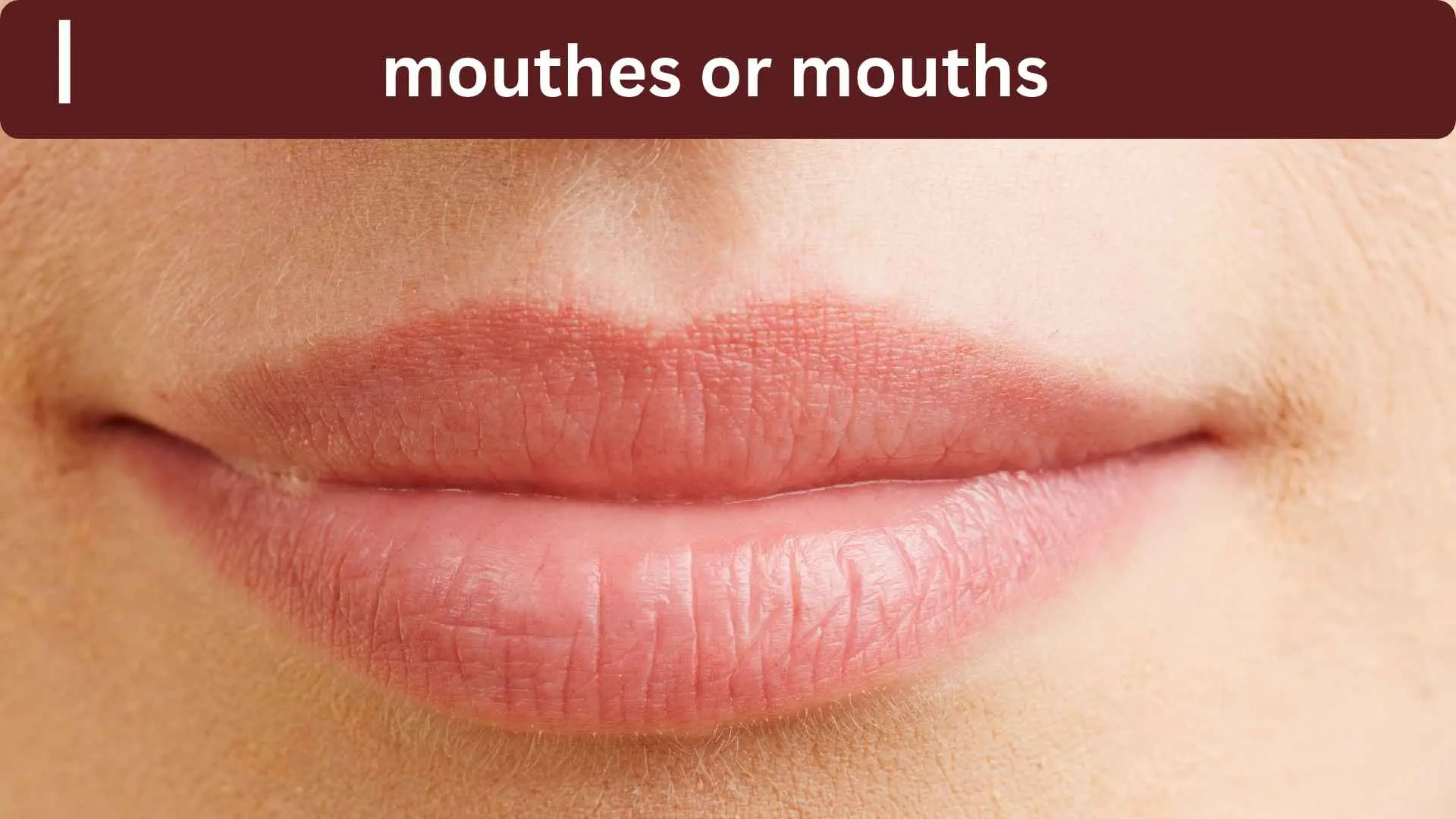
Mouthes or mouths is a common spelling question that can confuse English learners, students, and writers. When talking about more than one mouth, you might wonder which spelling is grammatically correct.
The answer is simple: mouths is the correct plural form of mouth, while mouthes is considered incorrect in standard modern English.
English plural rules are not always easy to understand. Some words add s, others add es, and a few change their spelling completely. For example, box becomes boxes, but mouth becomes mouths.
These differences can make spelling challenging, especially for people learning English as a second language.
Understanding the difference helps you write more confidently in school assignments, emails, professional documents, and everyday conversations.
This guide explains the correct spelling, meaning, pronunciation, plural rules, grammatical uses, common mistakes, and real-life examples. You’ll also learn why people confuse these spellings and how to remember the correct form.
Mouthes or Mouths: Which Spelling Is Correct?
The correct spelling is mouths. It is the standard plural form of the noun mouth.
The spelling mouthes is not accepted as the regular plural form in modern English.
A mouth is the opening in the face used for eating, drinking, speaking, and breathing. When referring to two or more mouths, simply add the letter s.
Correct: Mouth + s = Mouths
Incorrect: Mouth + es = Mouthes
For example:
- Correct: The children opened their mouths.
- Incorrect: The children opened their mouthes.
- Correct: The dogs have large mouths.
- Incorrect: The dogs have large mouthes.
- Correct: The babies put their fingers in their mouths.
- Incorrect: The babies put their fingers in their mouthes.
The correct plural spelling remains the same in American English, British English, and other major varieties of English.
Quick Comparison of Mouthes or Mouths
The following table explains the main differences.
| Feature | Mouths | Mouthes |
|---|---|---|
| Correct spelling | Yes | No |
| Standard English word | Yes | Not as the modern plural |
| Grammatical form | Plural noun or verb | Incorrect plural spelling |
| Meaning | More than one mouth when used as a noun | No accepted modern plural meaning |
| Dictionary usage | Recognized | Not recognized as a standard modern plural |
| American English | Correct | Incorrect |
| British English | Correct | Incorrect |
| Example | The children opened their mouths. | The children opened their mouthes. |
Key takeaway: Always use mouths when referring to more than one mouth.
Why Do People Confuse Mouthes or Mouths?
People commonly confuse these spellings because English nouns follow different plural patterns.
For example:
- Box becomes boxes.
- Brush becomes brushes.
- Church becomes churches.
- Watch becomes watches.
- Mouth becomes mouths.
A learner might assume that every word ending with a combination of consonants requires es.
However, the th ending in mouth does not require an extra e.
Pronunciation can also contribute to confusion. The plural noun mouths contains consonant sounds that some English learners find difficult to pronounce.
This sometimes leads to incorrect spelling.
What Does Mouths Mean?
The word mouths is the plural form of mouth. It refers to more than one mouth belonging to people, animals, or other living creatures.
A mouth is an important body part involved in eating, drinking, speaking, breathing, and other functions.
When discussing several people or animals, the plural form is often necessary.
Examples:
- The children covered their mouths while coughing.
- The dogs opened their mouths after running.
- The fish moved their mouths underwater.
- The babies smiled with their mouths open.
- The students kept their mouths closed during the examination.
In each example, mouths refers to multiple mouths.
Literal Meaning of Mouths
The literal meaning describes the physical openings found on the faces or heads of humans and many animals.
For humans, the mouth contains structures such as the tongue, teeth, gums, and lips.
It plays an important role in communication and digestion.
Examples:
- The dentist examined the children’s mouths.
- The horses opened their mouths while eating.
- The singers moved their mouths while performing.
- The babies put their toys in their mouths.
- The animals have different shapes of mouths.
These sentences use the word in its physical sense.
Figurative Meaning of Mouths
The word mouths can also represent people who need food or financial support.
For example:
She works hard to feed five mouths.
In this sentence, mouths refers to five people who depend on someone for food.
Another example:
The family has several mouths to feed.
This expression is common in everyday English.
The word can also describe openings in natural or human-made objects.
Examples:
- The river has several mouths.
- The explorers examined the mouths of the caves.
- The workers stood near the mouths of the tunnels.
- The bottles have narrow mouths.
These examples show that mouths has several meanings beyond the human body.
Is Mouthes a Word in English?
Mouthes is not a standard modern English plural form of mouth.
It usually appears as a spelling mistake when someone wants to describe more than one mouth.
The correct spelling is mouths.
However, unusual historical spellings may appear in older texts. Historical usage does not make mouthes the accepted plural in present-day English.
For school assignments, professional communication, and modern writing, use mouths.
Why Is Mouthes Incorrect?
The spelling is incorrect because the noun mouth forms its plural by adding s without changing the original word.
Some English nouns require es, but mouth does not belong to that group.
Compare these examples:
| Singular | Correct Plural | Incorrect Plural |
|---|---|---|
| Mouth | Mouths | Mouthes |
| Path | Paths | Pathes |
| Bath | Baths | Bathes |
| Month | Months | Monthes |
| Truth | Truths | Truthes |
Notice that bathes is a valid English word, but it is a verb form rather than the plural of bath.
For example:
She bathes the baby every evening.
This distinction shows why spelling depends on grammatical function.
Common Reasons for Writing Mouthes
There are several reasons someone might accidentally write mouthes.
Confusion with ES plurals: Words such as boxes and dishes may lead writers to apply the same pattern incorrectly.
Pronunciation difficulties: The final sounds in mouths can be challenging, especially for beginners.
Overgeneralizing grammar rules: Learners may assume that nouns ending in th need es.
Typing errors: An extra e may appear accidentally during writing.
Limited exposure to written English: People who hear the word more often than they read it may be uncertain about its spelling.
Recognizing these causes makes the mistake easier to avoid.
Why Is the Plural of Mouth Mouths?
The plural of mouth is mouths because the noun follows the regular English plural rule of adding s.
Unlike irregular nouns such as tooth or foot, the word mouth does not change its internal spelling.
The process is straightforward:
Singular: Mouth
Plural: Mouths
Understanding the Regular Plural Rule
Most English countable nouns form their plurals by adding s.
Examples include:
| Singular | Plural |
|---|---|
| Book | Books |
| Chair | Chairs |
| Hand | Hands |
| Table | Tables |
| Mouth | Mouths |
| Path | Paths |
| Month | Months |
| Truth | Truths |
These words follow the same basic spelling pattern.
For example:
- One book becomes two books.
- One chair becomes three chairs.
- One mouth becomes four mouths.
This rule is useful for understanding many common English nouns.
When Do English Nouns Add ES?
Some nouns form their plurals by adding es.
This commonly happens when a word ends in sounds such as /s/, /z/, /ʃ/, /tʃ/, or /dʒ/.
Examples:
| Singular | Plural |
|---|---|
| Box | Boxes |
| Bus | Buses |
| Dish | Dishes |
| Brush | Brushes |
| Church | Churches |
| Watch | Watches |
| Quiz | Quizzes |
The noun mouth ends with a th sound, so it does not follow this particular plural pattern.
Its correct plural remains mouths.
Are All Words Ending in TH Regular?
Not every English noun ending in th follows the same plural pattern.
For example:
- Mouth becomes mouths.
- Path becomes paths.
- Bath becomes baths.
- Tooth becomes teeth.
The word tooth is irregular because its vowel changes when forming the plural.
This is why learning the plural form of each unfamiliar noun is important.
Mouth or Mouths: Singular and Plural Explained
The difference between mouth and mouths depends on the number of mouths being discussed.
Use mouth for one.
Use mouths for more than one.
When to Use Mouth
Mouth is a singular countable noun.
Examples:
- The baby opened her mouth.
- The dog carried a toy in its mouth.
- The dentist examined my mouth.
- The child covered his mouth.
- The cave has a wide mouth.
Each sentence refers to one mouth.
When to Use Mouths
Mouths is the plural noun.
Examples:
- The babies opened their mouths.
- The dogs carried toys in their mouths.
- The dentist examined the patients’ mouths.
- The children covered their mouths.
- The caves have wide mouths.
Each sentence refers to multiple mouths.
Singular and Plural Sentence Comparison
| Singular | Plural |
|---|---|
| The child opened his mouth. | The children opened their mouths. |
| The dog has a small mouth. | The dogs have small mouths. |
| The baby closed her mouth. | The babies closed their mouths. |
| The fish has a wide mouth. | The fish have wide mouths. |
| The cave has one mouth. | The caves have several mouths. |
The examples demonstrate how the noun changes according to quantity.
How to Pronounce Mouths Correctly
The pronunciation of mouths can be challenging because the word contains closely connected consonant sounds.
The singular noun mouth is usually pronounced:
/maʊθ/
The plural noun mouths is commonly pronounced:
/maʊðz/
The difference involves the final consonant sounds.
Pronunciation of Mouth
The word mouth begins with the /m/ sound.
The middle contains the diphthong /aʊ/, similar to the vowel sound in now.
The final sound is the voiceless /θ/, made by placing the tongue lightly between the teeth.
Pronunciation of Mouths
The plural noun mouths commonly changes the final th sound to the voiced /ð/ sound and adds /z/.
This creates the pronunciation /maʊðz/.
Some speakers may use slightly different pronunciations depending on accent and speaking style.
Mouths as a Verb Has a Different Pronunciation
The word mouths can also function as a verb.
For example:
She mouths the lyrics while listening to music.
Here, mouths means forming words with the lips, often without producing an audible voice.
The verb is typically pronounced /maʊθs/.
| Word | Grammar | Common Pronunciation |
|---|---|---|
| Mouth | Singular noun | /maʊθ/ |
| Mouths | Plural noun | /maʊðz/ |
| Mouths | Present-tense verb | /maʊθs/ |
Understanding these differences improves both speaking and listening skills.
Mouths as a Noun or Verb
The spelling mouths can have different grammatical functions.
Its meaning depends on how it appears in a sentence.
Mouths as a Plural Noun
As a noun, mouths refers to more than one mouth.
Examples:
- The children opened their mouths.
- The animals have sharp teeth inside their mouths.
- The patients rinsed their mouths.
- The birds opened their mouths for food.
Here, mouths identifies body parts.
Mouths as a Present-Tense Verb
As a verb, mouths is the third-person singular present form of mouth.
It usually means moving the lips to form words, often without making a sound.
Examples:
- She mouths the words of her favorite song.
- He mouths a silent apology.
- The actor mouths his lines during rehearsal.
- The student mouths the answer without speaking.
The subject is singular, but the verb ends in s because of the third-person singular present-tense rule.
How to Identify the Correct Meaning
Look at the word’s role in the sentence.
Example 1: The children opened their mouths.
Here, mouths is a plural noun.
Example 2: The actor mouths the words.
Here, mouths is a verb.
Understanding the sentence structure makes the difference clear.
Mouthes or Mouths: Correct and Incorrect Sentence Examples
Examples are one of the easiest ways to learn spelling and grammar.
The following sentences show how to use mouths correctly.
15 Correct Sentences Using Mouths
- The children opened their mouths to sing.
- The dogs kept their mouths open after running.
- The babies put their fingers in their mouths.
- The fish moved their mouths underwater.
- The dentist checked the patients’ mouths.
- The students covered their mouths while coughing.
- The horses moved their mouths while eating.
- The singers opened their mouths widely.
- The children smiled with their mouths open.
- The animals have different types of mouths.
- The doctors examined the children’s mouths.
- The birds opened their mouths to receive food.
- The caves had narrow mouths.
- The family had six mouths to feed.
- The students kept their mouths closed during the test.
Every sentence uses the correct plural spelling.
Common Incorrect Sentences and Corrections
| Incorrect Sentence | Correct Sentence |
|---|---|
| The babies opened their mouthes. | The babies opened their mouths. |
| The dogs have large mouthes. | The dogs have large mouths. |
| The children covered their mouthes. | The children covered their mouths. |
| The fish moved their mouthes. | The fish moved their mouths. |
| The singers opened their mouthes. | The singers opened their mouths. |
| The dentist checked their mouthes. | The dentist checked their mouths. |
| The animals have small mouthes. | The animals have small mouths. |
| The students closed their mouthes. | The students closed their mouths. |
The correction is consistent in every example.
Replace the incorrect mouthes with mouths.
Common Grammar Mistakes With Mouths
Even after learning the correct spelling, writers sometimes make related grammatical mistakes.
Understanding these errors can improve sentence accuracy.
Mistake 1: Adding an Unnecessary E
Incorrect:
The children opened their mouthes.
Correct:
The children opened their mouths.
The plural noun requires only s.
Mistake 2: Using Mouth Instead of Mouths
Incorrect:
The children covered their mouth.
Correct:
The children covered their mouths.
When discussing the individual mouths of several children, the plural noun is usually more natural.
However, context determines whether a singular noun is appropriate.
Mistake 3: Confusing Mouths or Mouth’s
The apostrophe changes the grammatical function.
Mouths is a plural noun or a present-tense verb.
Mouth’s is the singular possessive form of mouth. It may also represent a contraction in informal English.
Examples:
- The animals have large mouths.
- The mouth’s shape affects certain speech sounds.
- She mouths the words silently.
These sentences demonstrate different grammatical uses.
Mistake 4: Confusing Mouths or Mouths’
Mouths’ is the plural possessive form.
For example:
The mouths’ shapes were different.
This sentence refers to shapes belonging to multiple mouths.
Although grammatically correct, a clearer alternative is:
The shapes of the mouths were different.
Mistake 5: Confusing Mouths or Mouthfuls
Mouths refers to multiple mouths.
Mouthfuls refers to quantities of food, drink, or another substance that fill the mouth.
Examples:
- The children opened their mouths.
- She took two mouthfuls of water.
The words have different meanings and should not be used interchangeably.
Mouths in Common English Idioms and Expressions
The word mouth appears in many everyday English expressions.
Learning these phrases can improve vocabulary and make conversations more natural.
Mouths to Feed
The expression mouths to feed refers to people who depend on someone for food or financial support.
Example:
The father works hard because he has five mouths to feed.
Big Mouths
A person with a big mouth may talk too much or reveal private information.
Example:
The manager dislikes big mouths who share confidential information.
This expression is informal and can sound critical.
Word of Mouth
Word of mouth means information shared through personal conversations.
Example:
The small business became successful through word of mouth.
This expression uses the singular noun mouth.
Put Words in Someone’s Mouth
This expression means falsely suggesting that someone said or intended something.
Example:
Please don’t put words in my mouth.
Make Someone’s Mouth Water
This expression describes a strong desire to eat something delicious.
Example:
The smell of freshly baked bread made everyone’s mouth water.
Keep Your Mouth Shut
This informal expression means to remain silent or avoid revealing information.
Example:
He promised to keep his mouth shut about the surprise party.
These expressions show how mouth and mouths appear in both literal and figurative English.
Mouths in American English or British English
The correct plural spelling is mouths in both American English and British English.
Unlike words such as color or colour, there is no standard spelling difference for the plural of mouth.
American English Usage
American English uses mouths.
Example:
The children opened their mouths during the dental examination.
British English Usage
British English also uses mouths.
Example:
The pupils covered their mouths while coughing.
Spelling Across English Varieties
| English Variety | Correct Spelling |
|---|---|
| American English | Mouths |
| British English | Mouths |
| Australian English | Mouths |
| Canadian English | Mouths |
| New Zealand English | Mouths |
| Indian English | Mouths |
The spelling is consistent across these varieties.
Pronunciation may differ slightly according to accent, but the written form remains unchanged.
Similar English Words and Their Plural Forms
Comparing related words can help you remember the correct spelling.
Regular Plurals Ending in TH
Many nouns ending in th form their plurals by adding s.
| Singular | Plural |
|---|---|
| Mouth | Mouths |
| Path | Paths |
| Bath | Baths |
| Month | Months |
| Length | Lengths |
| Birth | Births |
| Truth | Truths |
| Cloth | Cloths |
| Myth | Myths |
These words demonstrate a common plural spelling pattern.
Irregular Plurals
Some English nouns change their spelling when forming the plural.
| Singular | Plural |
|---|---|
| Tooth | Teeth |
| Foot | Feet |
| Goose | Geese |
| Mouse | Mice |
| Child | Children |
| Man | Men |
| Woman | Women |
| Person | People |
The noun mouth does not follow an irregular plural pattern.
Why Is Tooth Different From Mouth?
The words tooth and mouth both end in th, but their plurals follow different historical patterns.
Tooth has the irregular plural teeth.
Mouth has the regular plural mouths.
English contains words inherited from different historical grammatical patterns, which explains why similar endings do not always produce identical plurals.
For modern writing, remember each word’s accepted plural form.
How to Remember the Correct Spelling of Mouths
A few simple techniques can help you avoid confusing these spellings.
Use the Mouth Plus S Rule
Remember:
Mouth + S = Mouths
The word does not need an extra e.
This is the simplest spelling rule to memorize.
Connect Mouths With Similar Words
Think about nouns such as:
- Paths
- Baths
- Months
- Truths
- Births
These words also form their plurals by adding s.
Practice Short Phrases
Repeat these phrases:
- Two mouths
- Three mouths
- Many mouths
- Open mouths
- Small mouths
- Healthy mouths
Practicing short phrases can help the spelling become familiar.
Write Complete Sentences
Use the word in everyday sentences.
For example:
The babies opened their mouths.
The animals have different mouths.
The children covered their mouths.
Regular practice helps reinforce correct spelling.
Use a Dictionary When Unsure
A reliable dictionary can confirm the plural form of unfamiliar nouns.
Checking a word before using it in formal writing is a useful habit.
Why Correct Spelling Matters in Writing
Using the correct spelling helps readers understand your message without unnecessary confusion.
It is especially important in educational, professional, and published writing.
Academic Writing
Students should use standard spelling in assignments, examinations, and essays.
Example:
The scientist examined the mouths of several fish species.
Correct spelling supports clear academic communication.
Professional Writing
Reports, emails, and professional documents should follow standard grammar rules.
Example:
The veterinarian examined the animals’ mouths for signs of infection.
Creative Writing
Writers often describe facial expressions and body movements.
Example:
The frightened children stood silently with their mouths open.
The correct spelling helps the sentence read naturally.
However, correct spelling by itself does not guarantee higher search rankings.
Search engines also evaluate how well content meets user needs and provides reliable information.
Frequently Asked Questions About Mouthes or Mouths
Is It Mouthes or Mouths?
The correct spelling is mouths. It is the standard plural form of mouth. The spelling mouthes is incorrect when referring to more than one mouth in modern English.
What Is the Plural of Mouth?
The plural of mouth is mouths.
Example:
The children opened their mouths.
Is Mouthes a Real Word?
Mouthes is not a standard modern English plural noun. It usually appears as a spelling mistake. Use mouths in everyday and formal writing.
Why Is Mouths Correct Instead of Mouthes?
Mouths is correct because the singular noun mouth forms its plural by adding s. An additional e is unnecessary.
How Do You Spell Multiple Mouths?
The correct spelling is mouths.
Examples:
- Two mouths
- Three mouths
- Several mouths
- Many mouths
Is Mouths Singular or Plural?
Mouths is plural when used as a noun. However, it can also be a third-person singular present-tense verb.
Example:
She mouths the lyrics silently.
Is Mouths an Irregular Plural?
No. Mouths is a regular plural because it is formed by adding s to the singular noun.
What Is the Difference Between Mouths or Mouth’s?
Mouths is a plural noun or a present-tense verb.
Mouth’s is the singular possessive form or a contraction in certain contexts.
Example:
The mouth’s shape affects pronunciation.
What Is the Difference Between Mouths or Mouths’?
Mouths is the regular plural noun.
Mouths’ is the plural possessive form.
Example:
The mouths’ shapes were different.
Is Mouths Correct in American English?
Yes. Mouths is the correct plural spelling in American English.
Is Mouths Correct in British English?
Yes. British English also uses mouths as the standard plural form.
How Do You Pronounce Mouths?
The plural noun mouths is commonly pronounced /maʊðz/. The word contains a voiced th sound followed by a z sound.
Can Mouths Be Used as a Verb?
Yes. Mouths can mean forming words with the lips, often without making an audible sound.
Example:
He mouths the answer during the test.
What Is the Plural of Mouth in Animals?
The plural is mouths.
Example:
Different animals have different types of mouths.
What Is the Plural of Mouth in Medical Terminology?
The standard English plural remains mouths.
Example:
The dentist examined the patients’ mouths.
Medical writing may also use more specific anatomical terms depending on the context.
Is It Correct to Say Two Mouths?
Yes. Two mouths is grammatically correct.
Example:
The two animals have different mouths.
Why Do Some People Write Mouthes?
People may write mouthes because they confuse regular plurals with nouns that require es, misunderstand pronunciation, or make a typing mistake.
What Is the Easiest Way to Remember Mouths?
Remember the simple formula:
Mouth + s = Mouths
No extra e is needed.
Conclusion
The difference between mouthes or mouths is easy to understand once you learn the correct plural rule.
Mouths is the correct spelling, while mouthes is not the accepted plural form in standard modern English.
The singular noun mouth becomes mouths by adding the letter s. This applies when describing multiple mouths belonging to people, animals, or openings such as cave mouths and river mouths.
Remember that mouths can also function as a present-tense verb, although its meaning and pronunciation differ from the plural noun.
For accurate English writing, use mouths whenever you refer to more than one mouth.
The easiest rule to remember is simple: one mouth, two mouths, many mouths.

I am Charlotte Kensington, an education-focused writer who loves turning complicated ideas into simple and useful information. I write for readers who want to learn something new, improve their study habits, and develop practical skills. At Teachlora, my goal is to provide reliable and reader-friendly educational content that feels useful in real life. My books, A Better Way to Learn and The Curious Learner, explore simple approaches to learning and personal improvement.
Books:
- A Better Way to Learn
- The Curious Learner
 Oliver Harrington
 Eleanor Whitmore
 Nathaniel Brooks