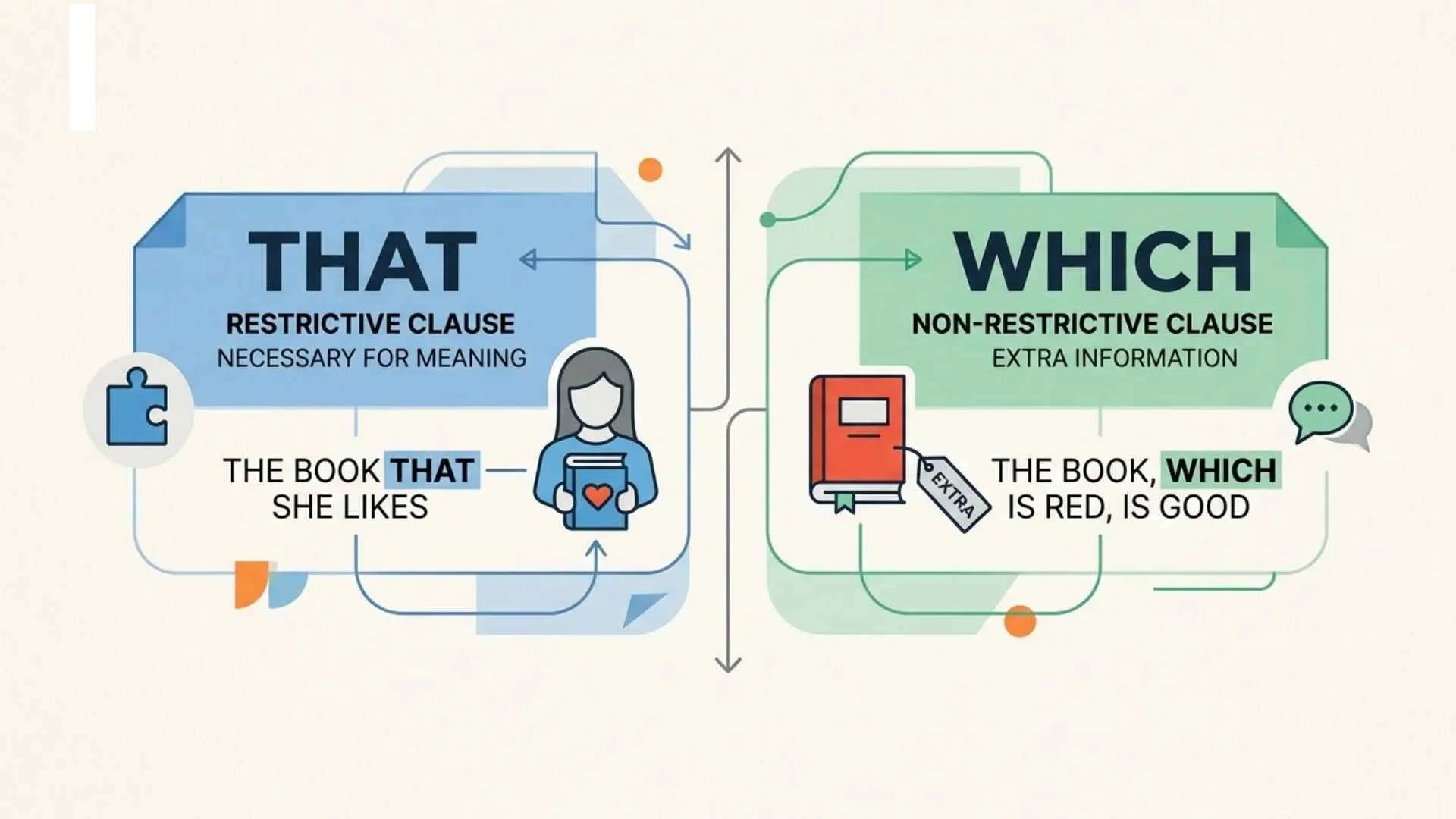
Choosing between that or which is a common English grammar challenge. Both words are used to introduce clauses that provide information about nouns, but they do not always have the same meaning or grammatical function.
Knowing when to use each word can help you write clearer sentences, avoid punctuation errors, and communicate your ideas more effectively.
The main difference between that or which is the type of information they introduce. In traditional American English grammar, that generally introduces a restrictive clause that provides essential information, while which commonly introduces a nonrestrictive clause that adds extra information.
Restrictive clauses usually do not require commas, whereas nonrestrictive clauses are separated by commas.
For example:
- The shirt that has a blue design belongs to my brother.
- My shirt, which has a blue design, belongs to my brother.
The first sentence identifies a particular shirt. The second sentence provides additional information about an already identified shirt.
In this detailed guide, you will learn the difference between that or which, their grammatical rules, comma placement, common mistakes, and examples for everyday and professional writing. You will also discover how American and British English use these words differently.
That or Which: What Is the Difference?
The words “that” and “which” are relative pronouns when they introduce relative clauses. They connect additional information to a noun or refer to an idea mentioned earlier.
However, their traditional usage differs depending on whether the information is essential or additional.
What Does That Mean in Grammar?
“That” is commonly used to introduce a restrictive relative clause. A restrictive clause provides information that is necessary to identify the particular person, place, object, or idea being discussed.
For example:
- The book that contains grammar exercises is mine.
- The employee that completed the project received a reward.
- The house that has a red door belongs to my uncle.
- I need a phone that has a good camera.
- She returned the shoes that she purchased yesterday.
In these sentences, the clauses beginning with “that” identify specific nouns. Without these details, readers may not know which book, employee, house, phone, or shoes the writer means.
What Does Which Mean in Grammar?
“Which” is commonly used to introduce a nonrestrictive relative clause. This type of clause adds information about a noun that is already identified.
For example:
- My book, which contains grammar exercises, is on the desk.
- Our manager, who has ten years of experience, leads the team.
- My house, which has a red door, is near the market.
- Her phone, which has a good camera, is quite expensive.
- The shoes, which she purchased yesterday, are comfortable.
The additional information makes each sentence more descriptive, but removing the clause does not change the basic identity of the noun.
Quick Comparison Between That and Which
| Grammar feature | That | Which |
|---|---|---|
| Main traditional use | Restrictive clauses | Nonrestrictive clauses |
| Information | Essential | Additional |
| Commas | Usually not required | Usually required |
| Refers to things | Yes | Yes |
| Refers to people | Yes, in restrictive clauses | Generally no |
| American English | Commonly preferred for restrictive clauses | Commonly preferred for nonrestrictive clauses |
| British English | Used in restrictive clauses | Can be used in both types |
When Should You Use That?
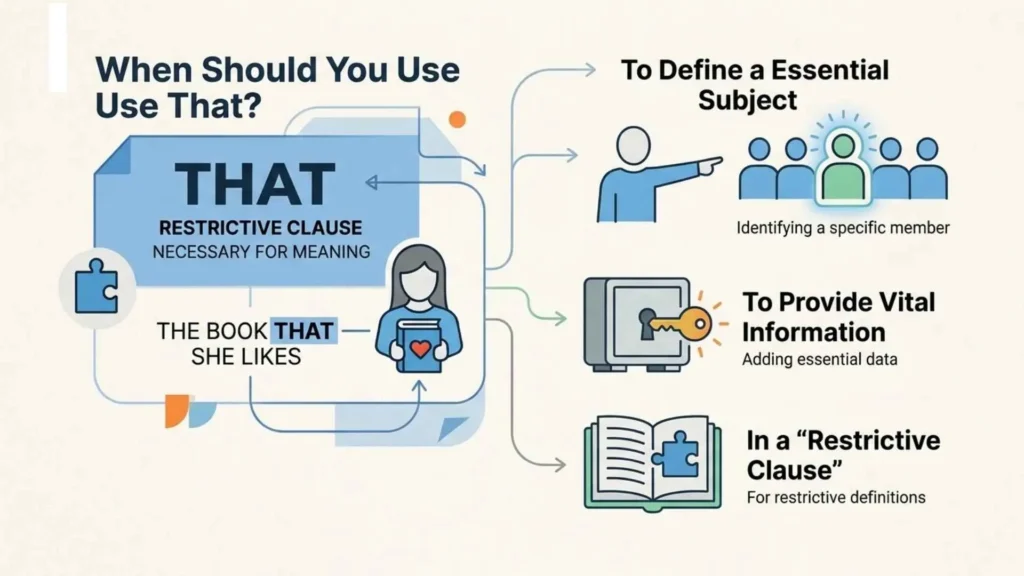
Use “that” when you want to identify a particular person or thing by providing essential information. This is especially useful when several similar people or objects exist and you need to distinguish one from the others.
In standard American English, “that” is generally preferred over “which” for restrictive clauses.
1. Use That for Essential Information
A restrictive clause gives readers information they need to understand exactly what you are discussing.
Examples:
- The students that passed the examination received certificates.
- The car that is parked outside belongs to my father.
- The restaurant that serves Italian food is nearby.
- The documents that you requested are ready.
- The movie that won the award is available online.
In these examples, the clauses identify particular students, cars, restaurants, documents, and movies.
Consider this sentence:
“The car that is parked outside belongs to my father.”
If you remove “that is parked outside,” the sentence becomes “The car belongs to my father.”
The sentence is still grammatical, but the identifying detail is missing. The original clause helps readers understand which car the writer means.
2. Use That to Identify a Specific Object
When you want to distinguish one object from other similar objects, “that” can introduce the necessary identifying information.
Examples:
- Give me the pen that is beside the computer.
- I prefer the shoes that have black laces.
- She selected the dress that had golden buttons.
- He repaired the machine that stopped working.
- We need the report that contains the latest information.
These sentences show how restrictive clauses make descriptions more specific.
Without the clause, the reader might not know which pen, shoes, dress, machine, or report is being discussed.
3. Use That in Everyday Conversations
“That” is also common in everyday English because it helps speakers explain which person or thing they mean.
Examples:
- I like the food that you prepared.
- This is the song that I told you about.
- She found the keys that she had lost.
- He bought a camera that takes excellent pictures.
- They hired an employee that understands the job.
These examples demonstrate how “that” makes ordinary communication clear and direct.
4. Use That in Academic and Professional Writing
Restrictive clauses are useful in academic assignments, business reports, research papers, and professional documents.
Examples:
- The research that supports this conclusion was published recently.
- The policy that governs employee attendance was updated.
- Students that complete all assignments can receive additional credit.
- The equipment that meets safety requirements can be used.
- The information that appears in the report must be verified.
In professional writing, identifying the exact subject is important. Restrictive clauses help readers understand which information, policy, equipment, or group of people is being discussed.
When Should You Use Which?
Use “which” when you want to provide additional information about a noun that readers can already identify. The clause adds descriptive details without changing the main meaning of the sentence.
In traditional American English grammar, nonrestrictive clauses beginning with “which” are normally separated from the main sentence with commas.
1. Use Which to Add Extra Information
A nonrestrictive clause gives readers additional details about a person, place, object, or situation.
Examples:
- My laptop, which I purchased last month, works perfectly.
- The garden, which is full of flowers, looks beautiful.
- Her new dress, which she bought online, arrived yesterday.
- The school, which opened in 1985, has a large library.
- Our office, which is near the city center, is easy to find.
The main subjects are already clear. The clauses simply provide extra information.
2. Use Which to Describe Something Already Identified
Sometimes, the noun is already known to the reader. You can use “which” to add another detail about it.
Examples:
- I visited London, which is the capital of England.
- She purchased a new computer, which has a powerful processor.
- We stayed at a hotel, which offered free breakfast.
- He gave me a book, which contained useful advice.
- They moved into an apartment, which has three bedrooms.
The additional clauses make the sentences more informative without being necessary to identify the subjects.
3. Use Which With Commas
When “which” introduces a nonrestrictive clause, commas separate the extra information from the main sentence.
Examples:
- My car, which is ten years old, still runs smoothly.
- The meeting, which lasted two hours, was productive.
- The presentation, which included several examples, was helpful.
- Her phone, which has a large screen, is expensive.
When the clause appears in the middle of a sentence, use a comma before and after it.
When the clause appears at the end, use one comma before it.
For example:
- She bought a new laptop, which was quite expensive.
- We visited a historic building, which was built centuries ago.
4. Use Which to Explain a Previous Situation
“Which” can also refer to an entire idea or situation in the preceding part of a sentence.
Examples:
- He missed the train, which made him late for work.
- She forgot her appointment, which caused a problem.
- The company reduced its prices, which attracted more customers.
- They canceled the event, which disappointed many people.
- The weather changed suddenly, which delayed the outdoor activities.
In these sentences, “which” does not simply describe one noun. It refers to the entire situation mentioned before it.
Restrictive or Nonrestrictive Clauses: Understanding the Grammar
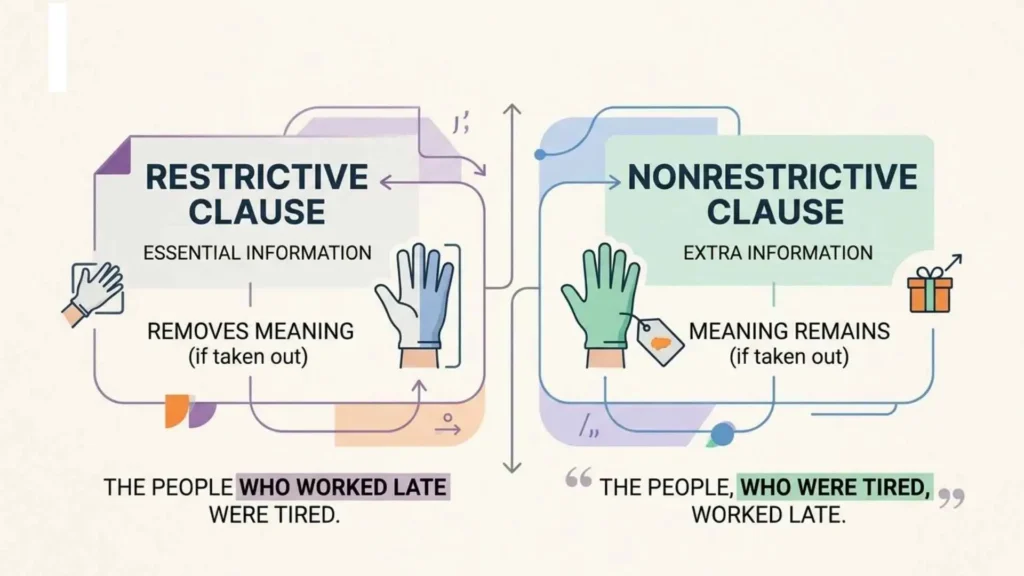
Understanding restrictive and nonrestrictive clauses is the most important step in learning the difference between that or which.
Both types of clauses provide information, but they do not serve the same purpose.
What Is a Restrictive Clause?
A restrictive clause is a group of words that identifies or limits the meaning of a noun. The information is essential to understanding which person or thing the sentence describes.
Examples:
- The dog that has a brown collar belongs to Sarah.
- The students that completed their homework received certificates.
- The restaurant that serves fresh seafood is popular.
- The files that contain confidential information must be protected.
- The house that stands near the river is for sale.
If you remove the restrictive clauses, you lose important identifying information.
For example:
“The dog that has a brown collar belongs to Sarah.”
Without the clause, the sentence becomes “The dog belongs to Sarah.” The reader no longer knows which dog the writer is identifying.
Restrictive clauses are not surrounded by commas.
What Is a Nonrestrictive Clause?
A nonrestrictive clause adds information about a noun that is already sufficiently identified. Removing the clause does not change the main meaning of the sentence.
Examples:
- Sarah’s dog, which has a brown collar, is very friendly.
- Our school, which opened in 1980, has a large library.
- The museum, which attracts many tourists, is closed on Mondays.
- My bicycle, which I bought last year, needs a new tire.
- The company, which employs hundreds of people, operates internationally.
Consider this example:
“Our school, which opened in 1980, has a large library.”
If you remove the additional information, the sentence becomes “Our school has a large library.”
The main message remains complete. This is why the clause is nonrestrictive and requires commas.
How to Identify the Correct Clause
Use these questions to decide which type of clause you need:
- Does the information identify a particular person or thing?
- Would removing the clause make the sentence unclear or change its intended meaning?
- Is the information simply an additional detail?
- Can the main sentence stand clearly without the clause?
If the information is essential, it is restrictive. If it is additional, it is nonrestrictive.
Punctuation Rules for That or Which
Punctuation plays an important role in choosing between these words. Correct comma placement helps readers understand the relationship between the main sentence and the additional information.
1. Do Not Use Commas Around Restrictive That Clauses
Restrictive clauses contain essential information. Therefore, they should not be separated from the main sentence with commas.
Correct examples:
- The house that has a white fence is ours.
- The book that you recommended was helpful.
- The employees that work remotely need internet access.
- The phone that I purchased yesterday is expensive.
Incorrect examples:
- The house, that has a white fence, is ours.
- The book, that you recommended, was helpful.
- The employees, that work remotely, need internet access.
The commas in the incorrect examples separate information that is necessary to identify the nouns.
2. Use Commas Around Nonrestrictive Which Clauses
Nonrestrictive clauses provide additional information. They should be separated from the main sentence with commas.
Correct examples:
- My house, which has a white fence, is easy to recognize.
- The book, which you recommended, was helpful.
- Our office, which is near the city center, is easy to find.
- My bicycle, which I bought last year, needs repairs.
These commas tell readers that the information is additional rather than essential.
3. Use One Comma Before Which at the End
When a nonrestrictive clause appears at the end of a sentence, place one comma before “which.”
Examples:
- She purchased a new laptop, which was quite expensive.
- We visited an old castle, which attracts thousands of tourists.
- He missed his flight, which caused several problems.
- The company opened another branch, which created new jobs.
You do not need a second comma because the clause ends with the sentence.
That or Which in American or British English
American and British English sometimes follow different conventions when using restrictive relative clauses.
Understanding these differences is helpful if you write for international readers, publish online content, or prepare academic documents.
That or Which in American English
Traditional American English grammar generally follows the distinction between “that” and “which.”
Use “that” for restrictive clauses and “which” for nonrestrictive clauses.
Examples:
- The car that has a broken window belongs to my uncle.
- My uncle’s car, which has a broken window, needs repair.
- The book that explains English grammar is useful.
- My English book, which explains several grammar rules, is useful.
This approach is widely taught in American writing guides and is commonly called the restrictive “that” and nonrestrictive “which” convention.
That or Which in British English
British English is more flexible about using “which” in restrictive clauses.
For example:
- The car which has a broken window belongs to my uncle.
- The book which explains English grammar is useful.
These constructions are generally acceptable in British English without changing the restrictive meaning.
However, nonrestrictive clauses still commonly use commas.
If you are writing for an American audience, using “that” for restrictive clauses and “which” for nonrestrictive clauses is a reliable style choice. For British audiences, either word may be appropriate in restrictive clauses, depending on the publication’s style guide.
Can You Use That for People?
Yes. “That” can refer to people when it introduces a restrictive clause. However, “who” is often preferred because it specifically refers to a person.
Examples of That Referring to People
- The student that won the competition received a medal.
- The employee that completed the project received a bonus.
- The person that called you is waiting outside.
- The teacher that explained the lesson was helpful.
- The customer that placed the order needs assistance.
These sentences are grammatically acceptable.
When Should You Prefer Who?
Although “that” can refer to people in restrictive clauses, “who” is often more natural and personal.
Examples:
- The student who won the competition received a medal.
- The employee who completed the project received a bonus.
- The person who called you is waiting outside.
- The teacher who explained the lesson was helpful.
For nonrestrictive clauses referring to people, use “who” rather than “which.”
Example:
“My teacher, who has twenty years of experience, explains grammar clearly.”
Common Mistakes When Using That or Which
Writers sometimes use these words incorrectly because their meanings overlap. Understanding common mistakes can help you improve your grammar and punctuation.
1. Using Which for Essential Information in Traditional American English
Incorrect for the intended restrictive meaning under the traditional American convention:
The car which has a broken window belongs to my uncle.
Preferred American English version:
The car that has a broken window belongs to my uncle.
The clause identifies a particular car, so “that” is the traditional choice.
2. Using That for Additional Information
Incorrect:
My laptop that I purchased yesterday, is expensive.
Correct:
My laptop, which I purchased yesterday, is expensive.
The second sentence uses commas to separate additional information from the main sentence.
3. Forgetting Commas Around Which Clauses
Incorrect:
My house which is near the market is beautiful.
If the location is additional information and the house is already identified, write:
My house, which is near the market, is beautiful.
The commas make the sentence easier to understand.
4. Adding Unnecessary Commas Around That
Incorrect:
The movie, that we watched yesterday, was excellent.
Correct:
The movie that we watched yesterday was excellent.
The clause identifies the particular movie, so it should not be separated with commas.
5. Confusing Which With Who
Use “who” when referring to people in nonrestrictive clauses. Use “which” when referring to things or animals.
Incorrect:
My brother, which lives in London, is visiting me.
Correct:
My brother, who lives in London, is visiting me.
The word “who” is appropriate because the sentence refers to a person.
Easy Tricks to Remember That or Which
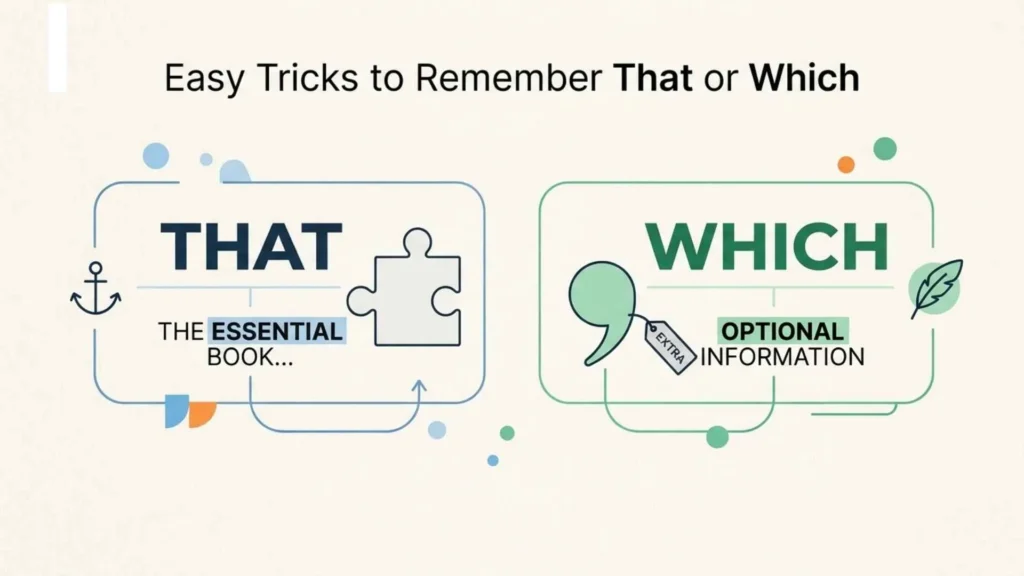
If you frequently confuse these words, use the following simple techniques to make the correct choice.
1. Remember the Comma Test
The comma test is one of the easiest ways to remember the traditional American English rule.
- Essential information: Use “that” without commas.
- Additional information: Use “which” with commas.
Example:
The car that is parked outside belongs to my father.
My father’s car, which is parked outside, needs cleaning.
The first clause identifies the car. The second clause adds information about an already identified car.
2. Try the Removal Test
Remove the clause from the sentence and read what remains.
If removing the clause changes which person or thing you are discussing, the information is probably restrictive.
If the sentence still identifies the subject clearly, the information may be nonrestrictive.
Example 1:
The phone that has a cracked screen is mine.
Without the clause, the sentence becomes “The phone is mine.” The identifying detail is missing.
Example 2:
My phone, which has a cracked screen, still works.
Without the clause, the sentence becomes “My phone still works.” The main message remains clear.
3. Use the Extra Information Test
Think of “which” as a way to add an extra detail.
Example:
My phone, which has a large screen, is expensive.
The screen size is additional information.
Think of “that” as a way to identify something.
Example:
The phone that has a large screen is mine.
The clause identifies a particular phone.
That or Which Examples in Everyday Sentences
The following examples demonstrate how both words work in different situations. They can help you understand the difference and apply the rules in your own writing.
Examples With That
- The book that I bought yesterday is interesting.
- The house that has a garden is beautiful.
- The phone that she uses is expensive.
- The road that leads to the village is narrow.
- The movie that won the award is popular.
- The bag that contains my laptop is missing.
- The student that answered correctly received a prize.
- The restaurant that serves fresh food is crowded.
- The dress that she selected looks beautiful.
- The computer that needs repair is in my office.
Examples With Which
- My book, which I bought yesterday, is interesting.
- Our house, which has a garden, is beautiful.
- Her phone, which she uses daily, is expensive.
- This road, which leads to the village, is narrow.
- The movie, which won an award, is popular.
- My bag, which contains my laptop, is missing.
- The competition, which attracted many students, was successful.
- The restaurant, which serves fresh food, is crowded.
- Her dress, which she selected yesterday, looks beautiful.
- My computer, which needs repair, is in my office.
Comparison Table of That or Which
| That example | Which example |
|---|---|
| The car that has black doors is mine. | My car, which has black doors, is mine. |
| The house that has a balcony is available. | Our house, which has a balcony, is available. |
| The book that explains grammar is useful. | This book, which explains grammar, is useful. |
| The shop that sells flowers is nearby. | The flower shop, which sells roses, is nearby. |
| The laptop that has a fast processor is expensive. | My laptop, which has a fast processor, is expensive. |
Remember that these examples use different contexts to demonstrate the grammatical distinction. The correct choice depends on the information you intend to communicate.
Frequently Asked Questions About That or Which
Is That or Which Grammatically Correct?
Both “that” and “which” are grammatically correct. However, they have different traditional uses in American English. “That” generally introduces restrictive clauses, while “which” commonly introduces nonrestrictive clauses. The correct choice depends on the sentence’s meaning and punctuation.
What Is the Easiest Way to Remember That or Which?
Remember this simple rule: use “that” for essential information and “which” for additional information. In traditional American English, restrictive clauses introduced by “that” do not require commas, while nonrestrictive clauses introduced by “which” generally require commas.
Should I Use That or Which in American English?
In American English, “that” is generally preferred for restrictive clauses, while “which” is preferred for nonrestrictive clauses. Following this distinction can make your writing clearer and help you follow common American grammar conventions.
Can Which Replace That in a Sentence?
Sometimes, yes. British English commonly uses “which” in restrictive clauses. However, traditional American English generally prefers “that” when introducing essential information. Consider your audience and follow a consistent writing style.
Do You Put a Comma Before That?
Generally, no. A restrictive clause introduced by “that” does not require a comma. For example, “The shoes that I purchased are comfortable.” The clause identifies which shoes you mean.
Do You Always Put a Comma Before Which?
Not in every possible use of “which.” However, when “which” introduces a nonrestrictive clause, you generally need a comma before it. For example, “My car, which is ten years old, still works.”
Can That Refer to a Person?
Yes. “That” can refer to a person in a restrictive clause. For example, “The student that won the competition received a medal.” However, “who” is often preferred when referring to people.
Can Which Refer to a Person?
In standard modern English, “which” generally refers to things or animals rather than people. Use “who” when adding information about a person. For example, “My sister, who lives abroad, is visiting us.”
What Is the Difference Between That, Which, and Who?
“That” generally introduces essential information about people or things. “Which” commonly introduces additional information about things or animals. “Who” refers to people and can introduce both restrictive and nonrestrictive clauses.
Is Which More Formal Than That?
Neither word is automatically more formal than the other. Both are appropriate in professional, academic, and everyday writing. Their correct use depends on the type of clause and the meaning you want to communicate.
Can I Start a Sentence With Which?
Yes. “Which” can begin a question or a sentence that refers to something mentioned earlier.
Examples:
- Which book do you prefer?
- Which color looks better?
- The company changed its working hours. Which caused confusion among employees.
The last example is less natural in standard writing. A clearer version is: “The company changed its working hours, which caused confusion among employees.”
Is That or Which Better for Formal Writing?
Both words are suitable for formal writing when used correctly. In traditional American English, use “that” for restrictive clauses and “which” for nonrestrictive clauses. Also, follow the style guide required by your school, employer, or publication.
Conclusion
Understanding the difference between that or which can make your English writing clearer, more accurate, and more professional. Although both words introduce relative clauses, they serve different purposes in traditional American English grammar.
Use “that” when introducing essential information that identifies a particular person or thing. Restrictive clauses introduced by “that” generally do not require commas. Use “which” when adding extra information about an already identified subject, and separate the nonrestrictive clause with commas.
The easiest way to remember the difference is to ask whether the information is necessary to identify the noun. If it is essential, use “that” in traditional American English. If it is additional, use “which” with the appropriate punctuation.
With regular practice, you can confidently choose between these words in emails, essays, articles, academic assignments, and everyday conversations.

I am Nathaniel Brooks, a writer passionate about education and lifelong learning. I believe good educational content should be easy to understand, useful, and enjoyable to read. At Teachlora, I create helpful articles about learning techniques, study habits, general knowledge, and skills that can support readers in their educational journey. I have also written Learn Better Every Day and The Practical Student Handbook to help readers approach learning with more confidence.
Books:
- Learn Better Every Day
- The Practical Student Handbook
 Oliver Harrington