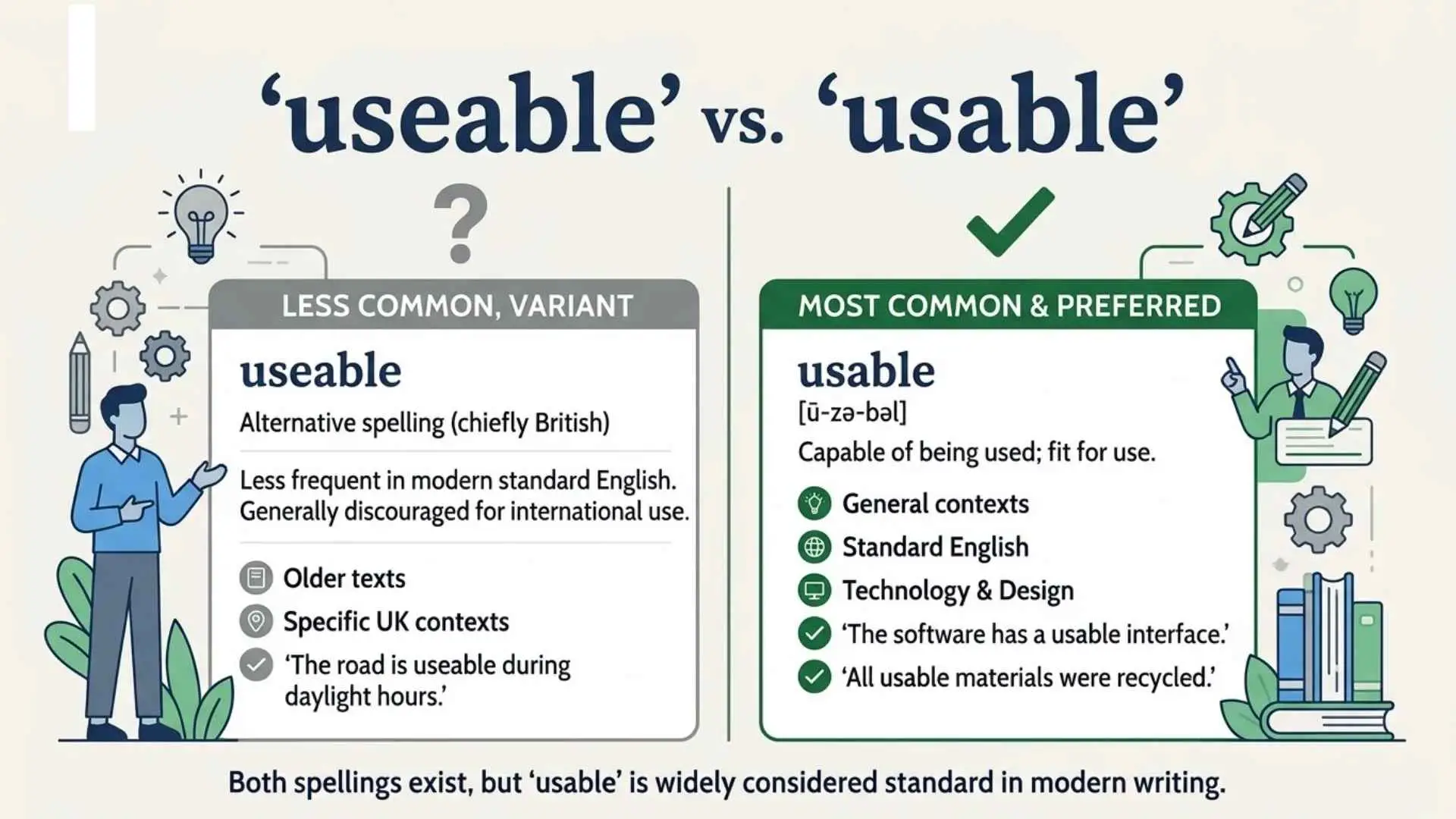
Choosing between useable or usable can be confusing because both spellings look correct and have the same meaning. You may see both forms in books, online articles, professional documents, and everyday writing. However, one spelling is much more common and widely preferred in modern English.
The correct and standard spelling is usable. It is an adjective that describes something that can be used, operated, or put to practical use. The alternative spelling, useable, is also accepted, but it is less common.
Understanding the difference between these spellings can help you improve your writing, avoid spelling mistakes, and communicate more clearly. If you are writing an academic assignment, business report, website article, or professional email, knowing which form to choose is important.
In this guide, you will learn the meaning of usable and useable, their spelling differences, grammar rules, common mistakes, synonyms, and practical sentence examples.
You will also find answers to frequently asked questions to help you understand which spelling to use in different situations.
Useable or Usable: Which Spelling Is Correct?
Both usable and useable are recognized English spellings. However, usable is the standard and more frequently used form in contemporary English.
The two words have the same meaning. They describe something that is suitable, practical, functional, or capable of being used for a particular purpose.
Here is a quick comparison:
| Spelling | Correctness | Meaning | Common Usage |
|---|---|---|---|
| Usable | Correct | Suitable for use | Very common |
| Useable | Correct | Suitable for use | Less common |
If you want to follow standard modern English spelling conventions, choose usable.
For example:
- Preferred: The new computer is still usable despite its age.
- Alternative: The new computer is still useable despite its age.
Both sentences are grammatically correct and communicate the same idea. However, the first spelling is more familiar to most readers.
Why Is Usable the Preferred Spelling?
The spelling usable follows a common English word-formation pattern. When the suffix -able is added to a word ending in a silent “e,” that final letter is often dropped.
For example:
- Use + able = Usable
- Value + able = Valuable
- Notice + able = Noticeable
- Excite + able = Excitable
This pattern explains why usable is the more common spelling.
Although useable retains the original “e,” it is not considered an entirely incorrect form. However, most writers prefer the shorter spelling because it is widely recognized.
Is Useable Incorrect?
No. Useable is an accepted alternative spelling of usable. It has the same pronunciation, grammatical function, and meaning.
However, it is much less common in everyday and professional writing.
Some writers retain the letter “e” because they want to preserve the connection with the original word use. Nevertheless, this is a matter of spelling preference rather than a difference in meaning.
For consistent and natural writing, usable is generally the recommended choice.
What Does Usable Mean?
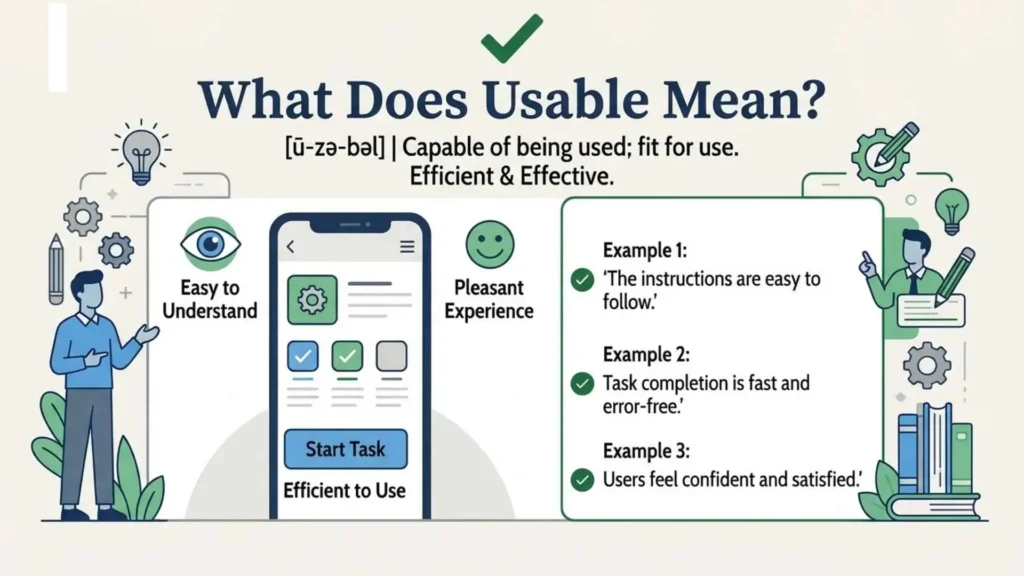
Usable is an adjective that means something can be used, operated, or applied for a particular purpose.
It describes an object, product, service, tool, resource, or space that is functional or suitable for use.
For example, if a computer turns on, runs programs, and allows someone to complete basic tasks, you can describe it as usable.
Similarly, a usable website allows visitors to find information, navigate different pages, and complete activities without unnecessary difficulty.
Simple Definition of Usable
The word usable can have several closely related meanings:
- Suitable for a particular purpose.
- Capable of being used.
- Ready or available for use.
- Functional enough to perform a task.
- Practical in a real-life situation.
- In a condition that allows someone to use it.
The exact meaning depends on the context in which the word appears.
For instance, a usable room is one that can serve a practical purpose. A usable tool is one that can perform its intended function.
Examples of Usable in Everyday English
Here are some examples that demonstrate how to use usable in ordinary communication.
- My old laptop is still usable for basic office work.
- We need a usable solution to this problem.
- The damaged chair is no longer usable.
- This website provides usable information for students.
- Only two rooms in the building are currently usable.
- The company developed a usable mobile application.
- Please check if the equipment is usable before the meeting.
- The road became usable again after the repairs.
- She converted the empty room into a usable workspace.
- The instructions should be clear and usable for beginners.
In all these examples, usable describes something that can serve a practical purpose.
What Does Useable Mean?
Useable is an alternative spelling of usable. It is an adjective that describes something capable of being used or suitable for a particular purpose.
The additional letter “e” does not change the definition or pronunciation.
For example:
- This old computer is still useable.
- We need a useable space for the new office.
- The information is useable for our research.
- Is this equipment still useable?
- The damaged furniture is barely useable.
Each sentence communicates the same meaning as its version using usable.
Why Do Some Writers Spell It Useable?
Some writers prefer useable because they retain the final “e” from the original word use.
English spelling contains different approaches to adding suffixes. Although dropping the final silent “e” is common before -able, some alternative forms remain in use.
This explains why both spellings appear in written English.
However, retaining the letter “e” is not necessary to make the meaning clear. The spelling usable is already well established and widely understood.
Is Useable an Adjective?
Yes. Useable is an adjective because it describes a noun.
For example:
- The equipment is useable.
- We need a useable website.
- This information is useable.
- The room is small but useable.
In each sentence, the word describes the condition or suitability of something.
The same grammatical rule applies to usable.
What Is the Difference Between Useable or Usable?
The main difference between useable and usable is their spelling and frequency of use. They do not have different definitions.
Both words describe something that can be used or is suitable for a particular purpose.
However, usable is more common in modern English and is generally preferred in professional writing.
1. Difference in Spelling
The most noticeable difference is the extra letter “e.”
- Usable: Contains six letters.
- Useable: Contains seven letters.
The shorter spelling is the standard form in contemporary English.
For example:
- This software is usable.
- This software is useable.
Both sentences are correct, but usable is the more common choice.
2. Difference in Meaning
There is no significant difference in meaning between the two spellings.
Both describe something that is functional, practical, or suitable for use.
For example:
- The old furniture is still usable.
- The old furniture is still useable.
Both sentences explain that the furniture can still serve a purpose.
3. Difference in Pronunciation
The words usable and useable are generally pronounced the same way.
The additional letter “e” in useable does not create a separate syllable or change the spoken meaning.
This means you do not need to pronounce them differently when speaking English.
4. Difference in Popularity
Usable is considerably more common than useable.
It is the spelling most readers expect to see in modern articles, educational materials, business communication, and technical writing.
Although useable is acceptable, its lower frequency can make it look unusual.
5. Difference in Formal Writing
Both forms can be understood in formal writing, but usable is generally the safer option.
For example:
- The research provides usable information.
- The organization needs a usable management system.
- The application offers a usable interface.
Using the standard spelling helps keep your writing consistent with common English conventions.
Usable or Useable: Examples in Sentences
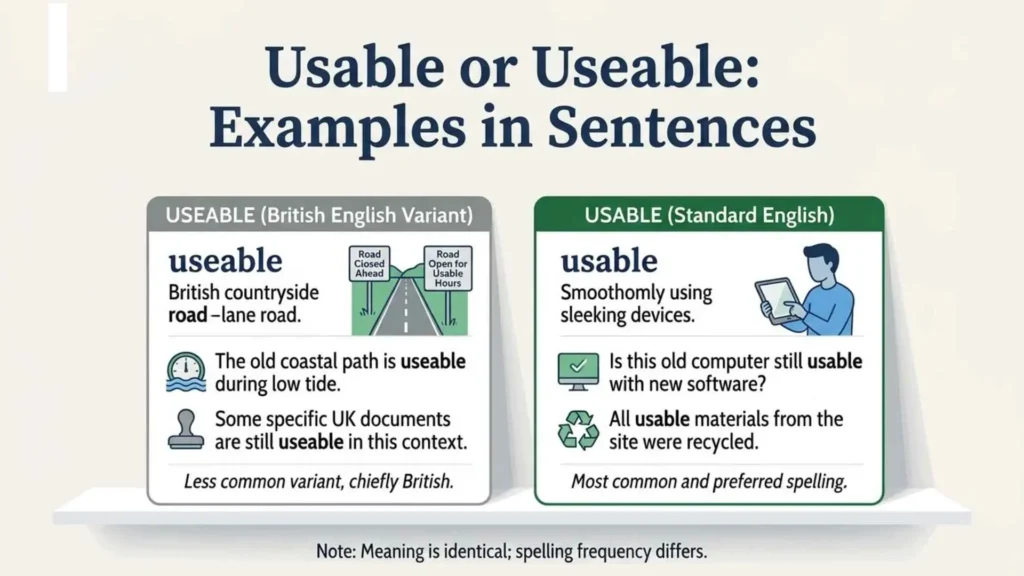
Understanding a word becomes easier when you see how it works in different sentences.
The following examples show how both spellings can be used in everyday, academic, professional, and technical communication.
15 Examples of Usable in Sentences
- The old mobile phone is still usable for making calls.
- We need a usable plan before starting the project.
- The website has a clean and usable design.
- This information is usable for our research paper.
- The building has several usable rooms.
- The company introduced a usable product for customers.
- My computer is usable even though it is quite old.
- The instructions should be simple and usable.
- The damaged road is no longer usable.
- She created a usable version of the document.
- The new application is usable on different devices.
- We collected enough usable data for the study.
- This tool is usable for everyday repairs.
- The kitchen is small but perfectly usable.
- The software provides a usable solution for businesses.
10 Examples of Useable in Sentences
- This old computer is still useable.
- We need a useable design for the website.
- The information is useable for our project.
- Is this equipment still useable?
- The room is small but useable.
- They created a useable version of the software.
- The material is useable for making furniture.
- We found a useable solution to the problem.
- The document contains several useable examples.
- The damaged road is barely useable.
These examples demonstrate that both forms have the same meaning. However, using usable throughout your writing is recommended because it is the more familiar spelling.
When Should You Use Usable?
You should use usable when describing something that can be used effectively or serves a practical purpose.
It is appropriate in many types of writing, including business communication, education, technology, and everyday conversations.
1. Usable in Business Writing
Businesses frequently use usable to describe products, services, equipment, resources, and systems.
For example:
- The company introduced a usable product for small businesses.
- We need a usable system to manage customer information.
- The new software provides a usable solution.
- Employees need usable instructions to complete their tasks.
- The organization developed a usable customer support platform.
In business writing, usable helps explain whether a product or system can perform its intended function.
2. Usable in Technology
Technology professionals often use this word when discussing websites, mobile applications, computer programs, and digital tools.
For example:
- The application has a simple and usable interface.
- Developers should create usable websites.
- The new system is more usable than the previous version.
- The software provides usable features for beginners.
- Users need a usable navigation system.
In this context, usable often describes how easily people can operate or interact with technology.
3. Usable in Education
Teachers, students, and researchers can use usable when discussing learning resources, educational materials, and research information.
For example:
- The library provides usable research materials.
- Students need usable information for their assignments.
- The teacher created a usable study guide.
- The research contains usable examples.
- We need usable resources for classroom activities.
The word helps explain whether educational materials can serve their intended purpose.
4. Usable in Everyday Conversations
You do not need to use usable only in formal writing. It is also suitable for ordinary conversations.
For example:
- Is this chair still usable?
- My old phone is still usable.
- We need a usable storage space.
- The kitchen is small but usable.
- This bag is usable for everyday shopping.
These examples show how naturally the word fits into everyday English.
5. Usable in Construction and Property
The word is also helpful when discussing buildings, rooms, roads, equipment, and other physical spaces.
For example:
- The house has three usable bedrooms.
- The construction team created more usable space.
- Only part of the building is currently usable.
- The road became usable after maintenance.
- The warehouse has enough usable storage space.
Here, usable describes whether a physical area or object can serve a practical function.
Common Spelling and Grammar Mistakes to Avoid
Although usable is relatively simple, writers sometimes confuse it with related words or use it incorrectly.
Understanding these common mistakes can improve your spelling and sentence structure.
1. Assuming Useable Is Always Wrong
One common mistake is believing that useable is completely incorrect.
It is an accepted alternative spelling, although it is much less common.
Instead of treating every occurrence as a spelling error, understand that usable is simply the more widely preferred form.
2. Confusing Usable With Useful
The words usable and useful are related, but their meanings are not identical.
- Usable: Something that can be used.
- Useful: Something that provides help or value.
Examples:
- The old computer is still usable.
- This computer is useful for editing videos.
A computer may be usable because it still works, but it may not be useful for every task.
3. Using Both Spellings in One Article
Switching between usable and useable can make your content inconsistent.
For example:
Incorrect style:
- This software is usable.
- The application is useable.
- We need a usable system.
Although the sentences are individually understandable, choosing one spelling throughout the document creates a more consistent style.
Use usable in your headings, paragraphs, examples, and FAQs.
4. Confusing Usable With Usability
Usable and usability are related words, but they serve different grammatical purposes.
- Usable: An adjective describing something that can be used.
- Usability: A noun describing how easy or effective something is to use.
Examples:
- The website is usable.
- The website has good usability.
The first sentence describes the website. The second discusses its ease of use.
5. Using Usable When You Mean Functional
Although usable and functional have similar meanings, they are not interchangeable in every situation.
Usable means something can be put to use. Functional generally means something works or performs its intended function.
For example:
- The old printer is still usable.
- The printer is fully functional.
The first statement means the printer can still be used. The second emphasizes that it works properly.
Usable vs Useful: What Is the Difference?
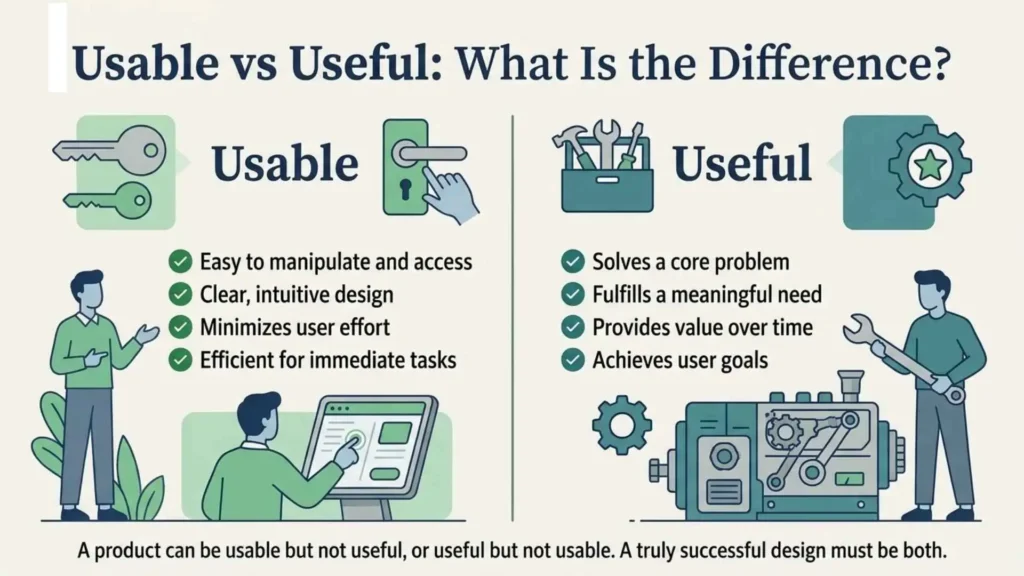
Many English learners and writers confuse usable with useful. Both words relate to the idea of using something, but they communicate different meanings.
Usable describes something that is capable of being used or is suitable for a particular purpose.
Useful describes something that provides help, value, or an advantage.
Consider the following comparison:
| Usable | Useful |
|---|---|
| The old phone is still usable. | The phone is useful for taking pictures. |
| The room is small but usable. | The room is useful for storage. |
| This software is usable. | This software is useful for editing videos. |
| The equipment is usable. | The equipment is useful for research. |
When to Use Usable
Choose usable when you want to explain that something can function or serve a particular purpose.
Example: The old laptop is still usable for basic office work.
When to Use Useful
Choose useful when you want to explain that something provides assistance or makes a task easier.
Example: This laptop is useful for completing office assignments.
Understanding this distinction helps you communicate your intended meaning more accurately.
Is Usable Correct in American English or British English?
Yes. Usable is accepted in both American English and British English.
Unlike spelling differences such as color or colour, the choice between usable and useable is not a major difference between American and British spelling.
Usable in American English
American English commonly uses usable in academic writing, business documents, websites, and everyday communication.
Examples:
- The software is easy to use and highly usable.
- We need a usable solution to this problem.
- The company created a usable application.
Useable is also understood, but it is less common.
Usable in British English
British English also recognizes usable as a standard spelling.
Examples:
- The equipment is still usable.
- The building has several usable rooms.
- We need to create a more usable website.
British writers may encounter the alternative spelling useable, but usable remains a widely recognized form.
Which Spelling Should International Writers Choose?
If you are writing for an international audience, choose usable.
It is widely recognized, easy to understand, and suitable for both American and British English readers.
Using the same spelling consistently also helps maintain a professional writing style.
Synonyms of Usable
Sometimes repeating the same word can make your writing sound unnatural. Using suitable synonyms can help improve vocabulary and make your sentences more interesting.
Here are some common synonyms of usable.
| Synonym | Meaning | Example |
|---|---|---|
| Functional | Working as intended | The machine is still functional. |
| Practical | Suitable for real situations | We need a practical solution. |
| Operable | Capable of being operated | The equipment is operable. |
| Serviceable | In good enough condition to use | The old vehicle is still serviceable. |
| Workable | Capable of being put into practice | They suggested a workable plan. |
| Accessible | Easy to reach or use | The information is accessible. |
| Suitable | Appropriate for a purpose | This room is suitable for meetings. |
| Available | Ready for use | The resources are available. |
| Effective | Producing the intended result | The method is effective. |
| Handy | Convenient or useful | This tool is handy for repairs. |
Positive Alternatives to Usable
If you want to describe something positively, consider these words:
- Practical
- Effective
- Functional
- Convenient
- Suitable
- Efficient
- Serviceable
For example, instead of writing “This is a usable tool,” you could write “This is a practical tool.”
Opposite Words of Usable
The opposite of usable depends on the context.
Common alternatives include:
- Unusable
- Nonfunctional
- Impractical
- Inoperable
- Defective
- Unavailable
- Ineffective
For example:
- The damaged machine is unusable.
- The broken equipment is nonfunctional.
- The proposed solution is impractical.
Frequently Asked Questions
1. Is It Useable or Usable?
Both spellings are accepted in English and have the same meaning. However, usable is the standard and more common spelling in modern English. It is the preferred choice for academic, professional, and everyday writing.
2. Is Useable a Real Word?
Yes. Useable is a recognized alternative spelling of usable. It describes something that can be used or is suitable for a particular purpose. However, it is much less common than usable.
3. Why Is Usable Spelled Without an E?
The final silent “e” in the word use is generally dropped when adding the suffix -able. This creates the standard spelling usable. Some writers retain the original “e,” resulting in the alternative spelling useable.
4. Which Spelling Is More Common, Usable or Useable?
Usable is considerably more common in contemporary English. It is widely preferred in dictionaries, educational materials, professional documents, and online content.
5. Is Usable an Adjective?
Yes. Usable is an adjective because it describes a noun. For example, in the sentence “This computer is usable,” the word describes the condition of the computer.
6. What Is the Opposite of Usable?
The most direct opposite of usable is unusable. Other alternatives include nonfunctional, inoperable, impractical, and ineffective. The appropriate word depends on the situation.
7. Is Unusable or Unuseable Correct?
Unusable is the standard and widely preferred spelling. It means something cannot be used or is not suitable for a particular purpose. Unuseable is a less common alternative.
8. Can I Use Usable in Formal Writing?
Yes. Usable is completely appropriate for formal writing. You can use it in academic assignments, business reports, professional emails, technical documents, and website articles.
9. Does Usable Mean Useful?
Not exactly. Usable means something can be used, while useful means something provides help, value, or benefit. Something can be usable without being particularly useful.
10. Is Usable Correct in Both British and American English?
Yes. Usable is accepted in both British and American English. It is a widely recognized spelling and works well for international audiences.
11. How Do You Pronounce Usable?
Usable is generally pronounced “YOO-zuh-buhl.” The alternative spelling useable has the same pronunciation and meaning.
12. What Is the Difference Between Usable and Usability?
Usable is an adjective that describes something capable of being used. Usability is a noun that describes how easy or effective something is to use.
For example:
- The website is usable.
- The website has excellent usability.
13. Can Useable Be Used in a Sentence?
Yes. Useable can be used in a sentence because it is an accepted alternative spelling. For example, “The old computer is still useable.” However, usable is the more common spelling.
14. Is Usable a Formal or Informal Word?
Usable is suitable for both formal and informal communication. You can use it in professional reports, academic writing, technical descriptions, and everyday conversations.
15. Should I Always Choose Usable?
For most modern English writing, yes. Usable is the more common and widely preferred spelling. Choosing it helps maintain consistency and makes your writing familiar to a broad audience.
Conclusion
When choosing between useable or usable, both spellings are accepted in English, but usable is the standard and more widely preferred form. Both words have the same meaning, pronunciation, and grammatical function. They describe something that can be used, operated, or put to practical use.
The spelling difference comes from the treatment of the final silent “e” in the original word use. When the suffix -able is added, the letter is generally dropped, creating usable.
If you are writing an academic assignment, professional email, business report, or website article, choose usable for consistency and familiarity. Remember this simple spelling pattern: Use + able = Usable.

I am Oliver Harrington, a writer interested in education, useful skills, and the many ways people can continue learning throughout life. I enjoy researching topics and presenting information in a clear, straightforward way. At Teachlora, I share educational insights, learning resources, study advice, and practical ideas designed to help readers grow their knowledge. I also wrote The Lifelong Learner’s Path and Simple Skills for Better Learning to encourage readers to make learning a regular part of life.
Books:
- The Lifelong Learner’s Path
- Simple Skills for Better Learning
 Nathaniel Brooks